Be Fruitful and Multiply Was Never Optional
The Christian family was never just a private arrangement. It was always a covenant with civilizational consequences.

– 5 min read

The Christian family was never just a private arrangement. It was always a covenant with civilizational consequences.
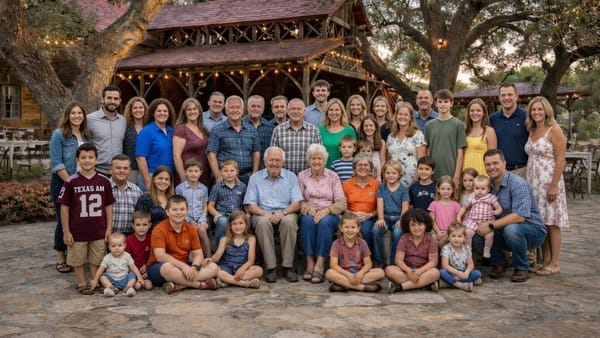
We have largely stopped taking it seriously. And the consequences are becoming impossible to ignore.
The data is not ambiguous. The United States fertility rate in 2023 was 1.6 births per woman — the lowest in recorded American history, and well below the 2.1 replacement rate needed to sustain a stable population. It has been in steady decline since 2007. Britain sits at 1.4. Italy at 1.2. Spain at 1.1. South Korea — a nation of nearly 52 million people — has collapsed to 0.7, which means it is on a trajectory to lose 80 percent of its population within a century.
Across Europe, deaths among Christians already outnumber births in 24 of 42 countries. The Pew Research Center projects that by 2035, Muslims will outnumber Christian births globally for the first time in history. By 2070, Islam is projected to reach population parity with Christianity worldwide.
These are not talking points. They are census data.
And within these numbers is a fact that deserves the church's full attention: the fertility decline in America is not evenly distributed. It has fallen far more sharply among the non-religious than among the devout. Christian women still have a slightly higher fertility rate than the unaffiliated — 1.9 versus 1.6. But 1.9 is still below replacement. It is still a population that is slowly, steadily shrinking. And the rate of young Americans leaving the faith is currently outpacing any gains from higher birth rates.
The church is not immune. It is just declining more slowly than everyone else.
How did the Christian family — historically the most civilization-building unit in the history of the Western world — come to treat fruitfulness as an afterthought?
The answer is not complicated. We absorbed the values of the culture around us and baptized them with just enough Christian language to feel comfortable.
The culture told us that children are expensive, and we agreed. The culture told us that careers come first, and we planned accordingly. The culture told us that two is practical and three is ambitious and four is eccentric, and we quietly adjusted our family plans to match. The culture told us that our bodies belong to us and our futures belong to us and our resources belong to us — and the church, which should have answered with a theology of covenant and abundance and the gift of life, largely went quiet.
We didn't reject the command to be fruitful and multiply. We just stopped preaching it. Stopped teaching it. Stopped living as if it meant something.
And a command that goes unpreached eventually becomes a command that goes unfollowed.
The Christian family was never designed to be a private arrangement between two people who happen to share a faith. It was always a covenant unit — a small civilization in miniature, producing the next generation of image-bearers, forming them in the faith, and sending them out into the culture as witnesses, workers, and world-changers.
Every child born into a covenant home is a stake driven into the future. A declaration that the family believes in tomorrow. That it trusts God with what it cannot control. That it is willing to pour itself out for something that will outlast it.
The early church understood this. In a Roman Empire that practiced widespread infanticide and abortion, Christians were conspicuous for welcoming children, adopting abandoned infants left to die on hillsides, and building families that treated every life as sacred. It was not just ethically distinctive. It was demographically transformative. The historian Rodney Stark has argued that the rapid growth of early Christianity was driven in significant part by this simple, countercultural fact: Christians had more children, kept more of them alive, and raised them in the faith.
They did not grow the church primarily through argument or strategy. They grew it through faithful fruitfulness.
Here is where the frame matters most.
A Guardian who has children because they are worried about birth rate statistics is building on sand. Anxiety about demographic trends is not a sufficient foundation for a covenant family. It will not sustain you through sleepless nights and financial strain and the long, unglamorous work of formation. Fear is not a strong enough reason to be fruitful.
But obedience is. Covenant is. The belief that children are a gift from God — not a lifestyle choice, not a financial calculation, not a strategic move in a culture war — is.
"Behold, children are a heritage from the Lord, the fruit of the womb a reward. Like arrows in the hand of a warrior are the children of one's youth. Blessed is the man who fills his quiver with them."
The Psalmist does not say children are a burden to be managed or a decision to be optimized. He calls them a heritage. A reward. Arrows — formed with care, aimed with purpose, released into a future the archer will never fully see.
The Christian family that embraces this vision is not trying to win a demographic contest. It is living in covenant faithfulness to a God who said the gift of new life is good — and who meant it.
The demographic consequences follow from that faithfulness. They are not the reason for it.
But let us also be clear about what the Psalmist knew and what a Guardian understands: arrows exist to be shot somewhere.
Children born into covenant homes are not just raised for their own flourishing. They are formed for the culture they will inherit and, God willing, reclaim. Every child raised in a home where Scripture is read and courage is modeled and truth is defended is a future teacher, a future leader, a future parent who will do the same for the generation after them. The compounding effect of faithful families across faithful generations is the most powerful civilizational force in human history.
This is not an accident. It is a design.
The culture that is losing its faith is also losing its children. The culture that keeps its faith, forms its children, and sends them out as Guardians into every sphere of society is the culture that endures — not because it out-strategized its opponents, but because it was faithful when faithfulness was costly and quiet and unspectacular.
If you are married, talk honestly with your spouse about whether your family planning decisions have been shaped more by the culture's values or by a prayerful reading of Scripture. Not with guilt — with honesty. God's command to be fruitful was given to people who trusted Him with what they could not control. That trust is still the invitation.
If you are a parent already, invest in the formation of the children you have with everything you can give. The quiver matters. So does the arrow. A child raised in deep faith, real courage, and covenant accountability is worth more to the Kingdom than ten children raised without roots.
And if you are a pastor or a church leader — preach this. The church went quiet on family, on children, on fruitfulness, on the theology of new life. The silence has cost us more than we know. It is time to recover what was always true.
Children are a heritage from the Lord. The arrows are still waiting to be formed.
Carry the Cross into the most important mission field you will ever have: your home.
Want to go deeper? Learn more about The Guardians' Cross → theguardianscross.org