

The Story
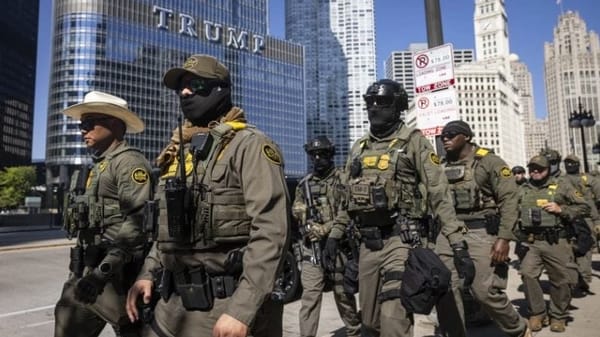
Chicago has become an unlikely frontline in America’s immigration crisis. In recent weeks, federal immigration enforcement operations have visibly intensified, with Border Patrol marine units and Immigration and Customs Enforcement (ICE) agents conducting operations in the city.
Border Patrol’s marine units, traditionally assigned to the Rio Grande and other southern waterways, have been redeployed to patrol transit corridors and waterways in Chicago. This is an unusual step, signaling the extent to which federal agencies are stretching resources to manage the record flow of migrants that has reached well beyond border states. At the same time, ICE agents have been seen downtown carrying out enforcement actions, processing migrants, and coordinating transfers.
For Chicago, the timing is critical. Since 2022, the city has received tens of thousands of migrants bused from Texas and other states as part of efforts to relieve border communities. While initially received with pledges of hospitality, the volume has quickly overwhelmed shelters, police stations, and city facilities. Migrants have been housed in makeshift shelters, gyms, and even police department lobbies. Residents in some neighborhoods have pushed back, raising concerns about safety, fairness, and the diversion of city resources from longtime citizens.
City leaders acknowledge they are struggling to cope. Chicago has spent hundreds of millions of dollars on housing, food, and support for new arrivals, with no clear long-term solution in sight. Local officials warn that funding gaps are widening and that public patience is wearing thin. “We cannot do this alone,” has become a common refrain from city and state leaders who argue the federal government has failed to provide adequate support.
Critics, however, point to the root cause: federal border policies that, they argue, have allowed unprecedented numbers of illegal crossings and encouraged migrants to push deeper into the United States. For them, the redeployment of Border Patrol and ICE to interior cities like Chicago is not a strategy but an admission that the crisis is out of control. Instead of enforcing at the line, enforcement is now reactive, spreading across the country as communities absorb the fallout.
The presence of Border Patrol and ICE in downtown Chicago has become a visible symbol of how immigration policy — or the lack thereof — now touches every corner of America. What once seemed a distant issue confined to Texas, Arizona, and California is now an urgent reality for cities in the Midwest and beyond. For many, it has shifted the immigration debate from abstraction to daily experience, reshaping local politics, community priorities, and national discourse.
Our Take
The deployment of Border Patrol and ICE into Chicago is a necessary response to years of reckless and even criminal neglect of the border by prior administrations. When sovereignty is ignored, crisis is inevitable. In that sense, this action is appropriate — but it is not victory. It is triage.
Yet the harder truth is this: we, the people, allowed it to come to this point. We were not vigilant. We tolerated weak policies, we accepted distraction, and we failed to demand accountability. A border does not collapse overnight; it collapses when a citizenry grows complacent.
This enforcement surge may slow the bleeding, but it will not heal the wound. Renewal requires more than pointing fingers at government — it requires citizens who reclaim vigilance, virtue, and responsibility. Guardians must lead in this by refusing passivity, demanding integrity, and embodying the strength of a people who refuse to be ruled by chaos.
A secured border is not simply a line in the sand; it is a reflection of a people willing to protect what they have been entrusted with. Renewal begins there — with us.