Globalism vs. National Development: Why Hamilton’s Vision Matters Today
A Guardian's guide to understanding the battle between global finance and national sovereignty—and why Hamilton's vision matters more than ever.

– 10 min read

A Guardian's guide to understanding the battle between global finance and national sovereignty—and why Hamilton's vision matters more than ever.
When you hear politicians and media figures invoke the "rules-based international order," they are not simply describing a set of trade agreements or diplomatic norms. They are naming a worldview—a framework of international institutions, trade regimes, and power networks that operate beyond the control of any single nation-state.
This globalist order stands in sharp contrast to what Alexander Hamilton, George Washington, and Abraham Lincoln called the American System—an economic and political philosophy rooted in national sovereignty, productive industry, and the creative capacity of free citizens.
Today's geopolitical tensions are not merely about tariffs or treaties. They reflect a deeper conflict between two fundamentally different answers to the question: Who should shape the future—financial elites managing global flows, or sovereign nations building productive economies for their own people?
This article unpacks the philosophical and practical differences between these two competing visions, and shows why Guardians must understand this battle to faithfully resist, reclaim, restore, and reign.
The globalist rules-based order emphasizes multilateral institutions, international regulation, and open borders for capital and goods. It is a system dominated by financial elites, global supply chains, and supranational authority—not national economic planning or the interests of local communities.
According to analysts at Promethean Action and similar organizations, this global order tends to hollow out national industries and prioritize finance over production. Wealth is measured not in what a nation can build, but in what it can trade, borrow, and speculate upon.
To understand the rules-based order, you must understand its architects. This system did not emerge by accident. It was built deliberately by financial powers with deep historical roots in the City of London—the square-mile financial district that has functioned as the world's premier banking center for centuries.
The City of London is not simply a place. It is an institution—a network of merchant banks, insurance syndicates, and financial houses that have operated with unique legal privileges since medieval times. Even today, the City maintains a degree of autonomy from the British government, with its own Lord Mayor and Corporation answerable primarily to financial guilds, not democratic accountability.
This system traces its lineage through:
The British Empire's Financial Model (1700s–1900s)
The British Empire was not primarily a military empire. It was a financial empire. The Bank of England, chartered in 1694, pioneered a model of sovereign debt whereby governments borrowed from private banks, creating perpetual indebtedness that enriched financiers while constraining national sovereignty.
Britain's empire extracted wealth through:
Alexander Hamilton explicitly rejected this model. His American System was designed to break free from British financial control and build a republic that could govern its own credit and develop its own productive capacity.
Bretton Woods and the Post-War Order (1944–1971)
After World War II, the United States briefly asserted a developmentalist vision through the Bretton Woods system, which tied currencies to the dollar and the dollar to gold. This system funded reconstruction and supported national industrial development.
But the City of London and allied financial interests worked to dismantle it. By 1971, President Nixon ended dollar-gold convertibility, opening the door to a new era of floating currencies, speculative finance, and the rise of institutions like the International Monetary Fund and World Bank—bodies that would use debt to enforce financial orthodoxy on developing nations.
Globalization and the "Washington Consensus" (1980s–present)
The modern rules-based order crystallized in the 1980s and 1990s through policies championed by the City of London, Wall Street, and compliant Western governments. The "Washington Consensus" prescribed:
These policies were presented as neutral economic wisdom. In reality, they served the interests of global financial networks that profited from volatility, debt, and the dismantling of national industries. The World Trade Organization, the European Union's monetary union, and countless trade agreements locked nations into this system, stripping them of the tools needed to pursue sovereign development.
The rules-based order promotes free trade and deregulation as universal goods, regardless of their impact on workers, families, or national industrial capacity. Power is exercised through networks of central banks, multinational corporations, and international institutions like the World Trade Organization, International Monetary Fund, and World Economic Forum.
The City of London remains at the center of this web. It is the world's leading hub for:
Critics argue that this system consistently benefits financial elites at the expense of working populations. Manufacturing jobs disappear. Communities collapse. Dependency replaces self-sufficiency. And when citizens object, they are told that "globalization is inevitable" and resistance is futile.
But it is not inevitable. It is a choice made by those who profit from it—and it can be unmade.
Some proponents of the American System describe this globalization as a modern confederacy—a system that hollowed out American manufacturing, displaced local production, and created economic dependency rather than self-sufficient growth.
Just as the old Confederacy sought to preserve a plantation economy dependent on external markets and financial control, the modern confederacy seeks to reduce nations to suppliers of raw materials and consumers of foreign goods—never sovereign producers capable of shaping their own economic destiny.
The American System originated with Alexander Hamilton, America's first Secretary of the Treasury under George Washington. It was later championed by Henry Clay and Abraham Lincoln, who used it to build the industrial might that won the Civil War and unified the nation.
Hamilton understood the American Revolution as an economic war as much as a political one. Britain sought to keep the colonies as suppliers of raw materials and captive markets for British manufactured goods. The Crown prohibited colonial manufacturing, controlled colonial currency, and used debt to maintain dependency.
Hamilton's system was designed to break this bondage. It was not about financial speculation or participation in global markets. It was about nation-building through economic independence—using sovereign credit, protective tariffs, internal improvements, and technological innovation to create a productive republic capable of defending its liberty and raising the standard of living for all its citizens.
The American Civil War was, in part, a continuation of this struggle. The Confederacy sought alliance with Britain and relied on cotton exports and British finance. The Union, under Lincoln, doubled down on Hamilton's vision: transcontinental railroads, land-grant colleges, the Homestead Act, and a national banking system that funded war production without submission to foreign creditors.
The American System rests on four pillars:
1. Sovereign Public Credit
Hamilton understood that a nation's credit should fund production, not merely service debt. His National Bank was nothing like the Federal Reserve. It was audited by the Treasury, could not monetize government debt, and existed to direct capital toward manufacturing, infrastructure, and innovation—not Wall Street speculation.
2. Support for Manufacturing
The American System used protective tariffs and strategic investment to grow real industrial capacity. Hamilton's Report on Manufactures argued that a nation dependent on foreign production for essential goods would never be truly free. Industrial independence was the foundation of political sovereignty.
3. Infrastructure Development
From the Erie Canal to the Transcontinental Railroad, the American System invested in canals, roads, and transportation networks as unifying national assets. These were not merely economic projects—they were acts of nation-building that connected communities, expanded commerce, and demonstrated what free citizens could accomplish together.
4. Scientific and Technological Advancement
The American System harnessed innovation for economic power, not financial extraction. It saw human creativity as the ultimate resource and sought to unleash it through education, research, and support for inventors and entrepreneurs.
Rather than relying on external financial forces to dictate national priorities, the American System sees citizens as creators and producers—empowering broad participation in wealth creation. It does not ask, "How can we integrate into global markets?" but "How can we build a productive economy that serves our people and secures our future?"
| Globalist Rules-Based Order | American System |
|---|---|
| Financial networks and elites | Industrial producers, workers, inventors |
| Global capital mobility | National productive capacity |
| Regulatory control across borders | Sovereign policy for national welfare |
| Supranational governance | Self-government under law |
Globalism prioritizes market integration over national development. It measures success by the free flow of capital, not the strength of communities or the dignity of work.
The American System prioritizes human creativity, infrastructure, and sovereign policy to raise living standards. It measures success by what a nation can build, not what it can borrow or trade.
One system sees nations as obstacles to be overcome. The other sees them as the natural expression of human community, rooted in shared history, language, law, and purpose.
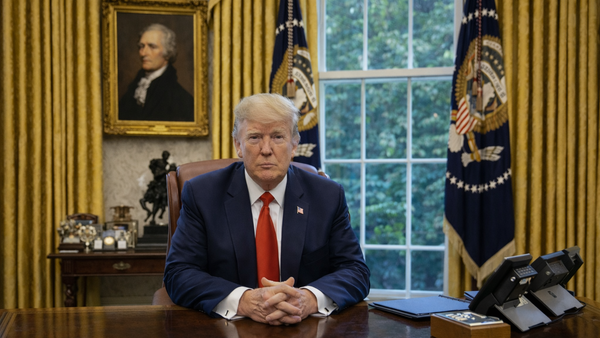
President Donald Trump's economic agenda represents the most direct challenge to the City of London's rules-based order in generations. Whether or not he uses Hamilton's language, Trump is attempting to extract the United States from the globalist system and rebuild the American System.
This is not rhetoric. It is policy.
Tariffs as Industrial Policy
Trump's use of tariffs breaks sharply with decades of globalist orthodoxy. Where the rules-based order insists that tariffs are protectionist relics that harm consumers, Trump understands what Hamilton knew: tariffs are tools of sovereignty and industrial development.
Tariffs serve multiple purposes:
The globalist establishment—media, academia, Wall Street—howls in protest. But their objections reveal their priorities: they care more about cheap imported goods and global supply chain efficiency than about American workers, communities, and sovereignty.
Reshoring and Onshoring Manufacturing
Trump has explicitly called for bringing manufacturing back to America. This includes:
This is not nostalgia. It is strategic necessity. A nation that cannot manufacture essential goods—from medicines to microchips to military equipment—is not sovereign. It is dependent. And dependency is control.
Withdrawing from Globalist Institutions
Trump has shown willingness to challenge or withdraw from multilateral institutions that constrain American sovereignty:
Each of these moves provokes outrage from the globalist class. But each also reclaims a measure of sovereign decision-making that had been ceded to supranational bodies.
Infrastructure and Energy Independence
Trump has championed:
Hamilton understood that infrastructure and energy are not luxuries—they are the foundation of national power. So does Trump.
Challenging Financial Elites
Perhaps most importantly, Trump represents a political coalition that no longer defers to Wall Street and the City of London. His base is not financiers, consultants, and Davos attendees. It is workers, small business owners, and families in the communities that globalization hollowed out.
This realignment terrifies the globalist establishment. They cannot control Trump the way they controlled previous administrations of both parties. And so they deploy every weapon at their disposal—media, intelligence agencies, lawfare, and international pressure—to stop him.
The Stakes of This Battle
Trump's attempt to implement the American System faces fierce resistance:
But the resistance also reveals the stakes. If Trump succeeds—if America rebuilds its industrial base, reclaims sovereign credit, invests in infrastructure, and governs its own economy for the benefit of its own people—he will have broken the City of London's centuries-old grip on global finance.
Other nations would follow. The rules-based order would fracture. And sovereign nations would once again have the freedom to pursue national development rather than submit to financial extraction.
This is why the globalist establishment fights Trump with such ferocity. They are not defending democracy or norms or decency. They are defending a system that enriches them at the expense of everyone else.
Current geopolitical tensions reflect a battle between returning to national development policies and reinforcing the global finance-centered rules that have dominated since the end of the Cold War.
So do efforts by other nations—China, Russia, India—to assert economic sovereignty and resist external financial control. These nations watch Trump's challenge to the globalist order with great interest. If America can break free, so can they.
The question is not whether nations will choose development or dependency. The question is whether America will reclaim the system that built its greatness, or continue to submit to a global order that treats its workers as expendable and its sovereignty as negotiable.
The American System sees sovereignty and national purpose as essential to human flourishing. It recognizes that free people must govern themselves under law, shape their own economic destiny, and build institutions that serve the common good—not distant elites.
Globalism, by contrast, sees value in shared institutions and integration—trusting supranational bodies to manage problems too complex for any single nation. But history shows that such bodies are rarely accountable to ordinary people, and their solutions often serve the powerful at the expense of the vulnerable.
The globalist order seeks a world shaped by financial flows and supranational governance—a world where nations are dissolved into markets, and citizenship is replaced by consumption.
Hamilton's American System is rooted in sovereign development, industrial power, and human creativity—a world where nations build, innovate, and govern themselves for the welfare of their own people.
These are not merely economic theories. They are visions of what it means to be human, to live in community, and to exercise dominion over creation.
For Guardians, the choice is clear.
We do not carry the cross into a world ruled by faceless institutions and financial extraction. We carry it into a world where nations can flourish, families can build, and free people can govern themselves under God.
Hamilton's American System is not a relic of the past. It is a blueprint for the future—a future where Guardians resist the lies of globalism, reclaim the vision of sovereign development, restore productive industry, and reign with Christ in every sphere of life.
The future belongs to those who build.
Will we be builders—or will we be managed?