The Anxious Republic
Nearly three in four Americans are anxious about the future of their country. That number tells us something important — not just about politics, but about what we have built our stability on.

– 3 min read

Nearly three in four Americans are anxious about the future of their country. That number tells us something important — not just about politics, but about what we have built our stability on.
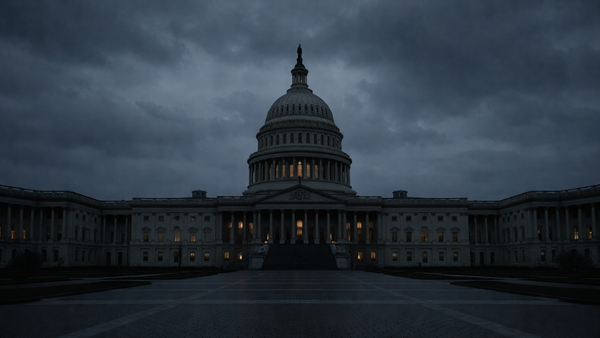
A new survey from Chapman University finds that 69% of Americans report significant anxiety about corrupt government officials — the top fear in the country for the tenth consecutive year. The American Psychiatric Association's data tracks in the same direction. Americans are not just frustrated with their government. They are afraid of what comes next.
That is worth sitting with for a moment. Not the political causes — those are debated endlessly. The number itself. More than two out of three people walking through their days carrying a low-grade fear about whether the country they live in is going to hold together.
The anxiety is not irrational. Institutions that once provided a stable backdrop for daily life — courts, schools, the press, Congress, the church — have lost the trust of significant portions of the population. Gallup's 2025 confidence in institutions survey found that just three institutions command majority-level confidence from Americans: small business (70%), the military (62%), and science (61%). Congress sits at roughly 10% — near the lowest Gallup has ever recorded for any institution.
When the scaffolding people once leaned on becomes unreliable, the weight transfers somewhere. Usually inward. And inward weight, carried without an anchor, becomes anxiety.
The political environment amplifies it. The news cycle is engineered for urgency. Social media rewards outrage over analysis. Every development — regardless of its actual significance — arrives packaged as a crisis. The cumulative effect is a population in a permanent state of low-grade alarm, conditioned to believe that the next headline could be the one that breaks everything.
There is something underneath the political anxiety worth naming honestly.
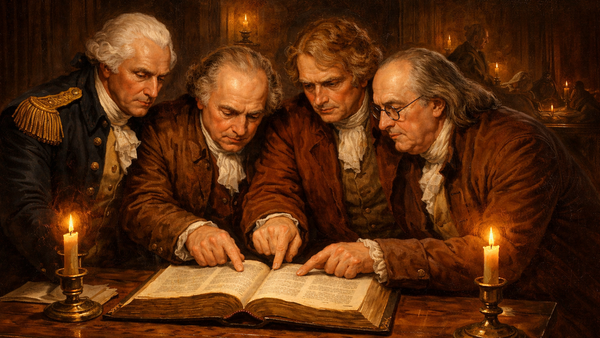
A society that has placed its stability primarily in its institutions was always going to feel this exposed when those institutions faltered. The founders understood this. John Adams wrote that the Constitution was designed for a moral and religious people and was wholly inadequate for the governance of any other. He was not making a theological argument. He was making a structural one. Self-governance requires a self that is capable of governing — formed, disciplined, rooted in something more durable than the outcomes of any particular election.
What the anxiety data reveals is not primarily a political crisis. It is a formation crisis expressing itself politically. The outer structures are shaking because the inner foundations were neglected first.
The instinctive response to institutional anxiety is to find better institutions — better leaders, better policies, better parties. That response is not wrong. But it is incomplete.
The more urgent question is not what kind of government we have, but what kind of people are operating within it. A nation of anxious, reactive, untethered citizens will reproduce anxious, reactive, untethered institutions regardless of who wins the next election. The cycle is self-perpetuating until something interrupts it at the level of formation, not just politics.
What interrupts it is the presence of men and women who are not running on the same anxiety. Not because they are naive about the stakes — they aren't. But because they have built their stability on something the polls cannot measure and the news cycle cannot touch. They show up to school board meetings settled. They engage in civic life without the desperation of people whose entire hope is riding on the outcome. They hold positions under pressure without bitterness. They are, in the precise sense of the word, a different kind of citizen.
That kind of citizen is not produced by a better platform or a stronger candidate. They are formed — slowly, deliberately, over time — by something much older than any political party.
The anxiety in the data is real. The causes are real. The stakes are real.
The question it puts to every serious person is not who to vote for. It is what you are building your stability on — and whether what you are building it on will hold when the pressure comes.
Because the pressure is coming. It always does.
The republic does not need more outrage. It has plenty. What it needs is men and women who have decided that who they are is more important than how the news makes them feel — and who show up every day to prove it.
Learn more about The Guardians' Cross → theguardianscross.org