The Collapse of Credibility — Rebuilding Trust in an Age of Deception
When truth is fractured, the people perish.

– 4 min read

When truth is fractured, the people perish.
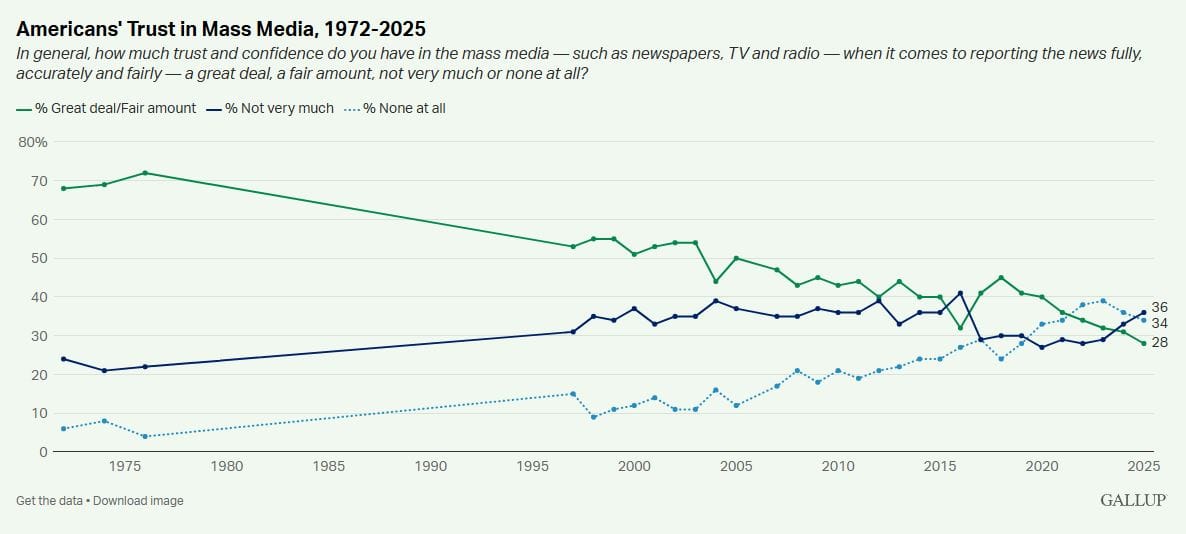
Confidence in the American press has reached its lowest point in recorded history. According to Gallup’s latest survey, released in October 2025, only 28% of U.S. adults say they have a “great deal” or “fair amount” of trust in newspapers, television, and radio to report the news fully, accurately, and fairly. That’s down from 31% last year and 40% just five years ago.
Meanwhile, seven in ten Americans now express little or no confidence in the media — 36% saying they have “not very much” trust and 34% saying “none at all.” This is the first time Gallup’s measure has fallen below 30% since it began tracking media confidence in the early 1970s.
When Gallup first asked this question between 1972 and 1976, between 68% and 72% of Americans said they trusted the media. Even in 1997, a majority — 53% — still expressed confidence in reporting. But since then, trust has trended relentlessly downward: 44% in 2004, 45% in 2018, and now 28% in 2025. The decline is no longer episodic; it is structural.
The 2025 data reveal record lows across every major group — Republicans, independents, and Democrats alike.
A generational divide has also deepened. Among Americans aged 65 and older, 43% still trust the media, while no younger age group exceeds 28%. In the early 2000s, confidence across all age groups hovered just above 50%. Since then, the decline has been universal — but older Americans have simply fallen more slowly.
Gallup’s analysis warns that this generational gap could accelerate the decline even further as younger adults — especially younger Democrats — replace older cohorts with comparatively little faith in journalism.
The takeaway is stark: trust in the media is not just declining; it is disintegrating. Once considered an indispensable pillar of self-government, the press now faces a collapse of legitimacy across party, age, and ideology. The erosion is not isolated to one group or administration — it is systemic, signaling a profound loss of public confidence in truth-telling institutions themselves.
The collapse of trust in the media is not only a professional failure — it is a cultural mirror. When nearly three-quarters of a nation no longer believe its news, the problem is deeper than bad reporting or political bias; it is a symptom of moral exhaustion.
Truth has become negotiable. Accuracy has been replaced by advocacy. What once was a calling to report facts has, for many, become a struggle to preserve narratives that reinforce identity or ideology. A people cannot live long on half-truths; they eventually choke on them.
Across history, civilizations have not fallen first by invasion but by confusion — when words lose meaning and truth becomes elastic. The moment people begin to suspect that everyone is spinning, not speaking plainly, they stop listening altogether. That silence is not neutrality; it’s despair.
We are watching that despair settle in. The erosion of trust in the press is part of a broader corrosion of faith — not merely in institutions, but in the very idea that truth exists, can be known, and should be told. What follows such erosion is fragmentation: when there is no common reality, there can be no common life.
And yet, within this breakdown lies an invitation. Every collapse of public credibility creates space for the rebuilding of private integrity — for men and women who still value truth not as strategy, but as sacred duty.
Through the Guardian’s Lens, we recognize that this decline in trust is both judgment and opportunity.
When the press loses its moral center, the people of truth must rise and take its place.
“Truth has fallen in the street, and equity cannot enter.” — Isaiah 59:14
“Therefore, each of you must put off falsehood and speak truthfully to your neighbor.” — Ephesians 4:25
The age of deception will not be conquered by louder voices but by truer ones.
Guardians must become living testaments of credibility — men and women whose integrity restores what institutions have lost.
When the culture no longer trusts the messenger, God sends a movement to embody the message.
READ THE GALLUP STORY HERE:
 Megan Brenan