They Always Said So
The founders were not quiet about the relationship between faith and self-governance. We have simply stopped listening.

– 6 min read

The founders were not quiet about the relationship between faith and self-governance. We have simply stopped listening.
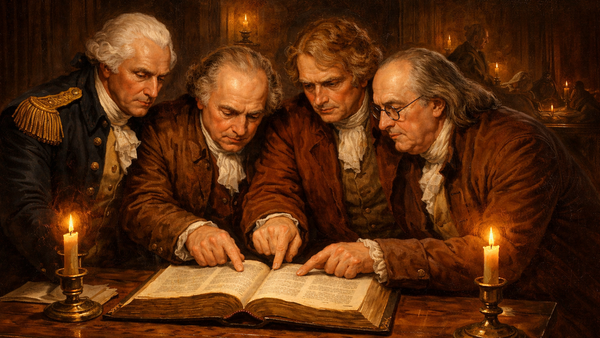
At some point in the last generation, a strange idea took hold: that the men who built this republic were secular visionaries who happened to use religious language as political decoration. That the faith woven through their speeches, their letters, and their governing documents was ornamental — a nod to the sensibilities of a simpler age, not a structural conviction about what makes a free people possible.
That idea is not history. It is revision. And the distance between those two things matters more right now than it has in a very long time.
In 1798, John Adams wrote to the Massachusetts Militia with words that have never been successfully argued away: "Our Constitution was made only for a moral and religious people. It is wholly inadequate to the government of any other."
He was not speaking of an established church. He was not calling for a theocracy. He was making a structural claim about republican government — that ordered liberty requires a people capable of governing themselves, and that self-governance requires moral formation, and that moral formation, in his world and his reading of history, had a source.
George Washington said it in his Farewell Address, the document he chose as his final word to the nation he had helped create: "Of all the dispositions and habits which lead to political prosperity, religion and morality are indispensable supports." He called anyone who claimed to be a patriot while undermining religion and morality a fool — not impolitely, but plainly.
Benjamin Rush, signer of the Declaration and founder of the American Sunday School movement, was more direct still. He argued that the Bible should be the primary text in every American school — not because he wanted to establish a state religion, but because he believed that without Scripture as the shared moral foundation, the American experiment would eventually devour itself.
Alexis de Tocqueville came from France in 1831 to study this unusual republic and understand why it was working when every European attempt at democracy had collapsed into chaos or tyranny. What he found surprised him. "I do not know," he wrote in Democracy in America, "whether all Americans have a sincere faith in their religion — for who can search the human heart? — but I am certain that they hold it to be indispensable to the maintenance of republican institutions."
An outside observer. No theological stake in the matter. Reporting what he saw.
What he saw was a people who understood that freedom is not self-sustaining. That liberty without virtue becomes license. That license, given time, becomes chaos. And that the only institution in American life capable of forming virtuous people at the scale a republic requires was the church.
None of this was controversial in 1831. It was barely controversial in 1931. The idea that serious Christian conviction was compatible with — and indeed necessary for — American self-governance was simply the operating assumption of the republic for the better part of three centuries.
What changed was not the historical record. The letters are still there. The speeches are still there. The Farewell Address is still there. What changed was the willingness of a particular class of cultural gatekeepers to take the record seriously — and the willingness of Christians, worn down by decades of being told their convictions were embarrassing, to stop citing it.
The label "Christian Nationalist" is, among other things, an attempt to make the founding record sound like a fringe position. To take what Adams and Washington and Rush and Tocqueville all said plainly and openly and reframe it as dangerous ideology. To convince serious believers that their convictions are a novelty — something new and suspect — rather than the inherited posture of the people who built this country.
It is a remarkable act of historical revisionism. And it only works on people who have forgotten what the record actually says.
The founders were not building a theocracy. They were explicit about that. The First Amendment means what it says. No established church. No religious test for office. The freedom to believe — or not believe — is among the foundational liberties of this republic.
But freedom of religion is not the same thing as freedom from religion. The founders knew the difference. They built a system that protected the church from the state precisely because they believed the church was doing something the state could not do: forming the kind of people a free republic requires.
What they understood — and what the last century of American life has been slowly unlearning — is that you cannot have the fruit without the root. You cannot have ordered liberty without moral formation. You cannot have moral formation at scale without the institutions that produce it. And you cannot hollow out those institutions and expect the republic to hold.
A Christian who believes that faith belongs in the public square is not importing something foreign into the American tradition. They are standing exactly where the founders stood — believing that the health of this nation is inseparable from the health of its moral and spiritual foundation, and that remaining silent on that point is not neutrality. It is abdication.
Know what you stand on. Not as a debating point — as an inheritance.
The men who signed the Declaration and built the Constitution were not embarrassed by their convictions. They wrote them down in letters and addresses and published them for anyone to read because they believed those convictions were true, load-bearing, and worth defending. They expected the people who came after them to do the same.
You are one of those people. The record is yours. The inheritance is yours. The moment is yours.
Carry it.
Know someone who needs to read this? Forward it. Subscribe free at theguardianscross.org
Know someone who needs to read this? Forward it. Subscribe free at theguardianscross.org
The America worth passing on will not build itself. It will be built by men and women of faith who know who they are and refuse to stand aside. TGC exists to equip those people — to help them step into their identity as Guardians and engage every sphere of this culture with the authority this moment demands.