They Told Her Daughter to Keep Secrets
A Maine mother found out what the school had done to her child. Then she found out the courts wouldn't help her.

– 4 min read

A Maine mother found out what the school had done to her child. Then she found out the courts wouldn't help her.
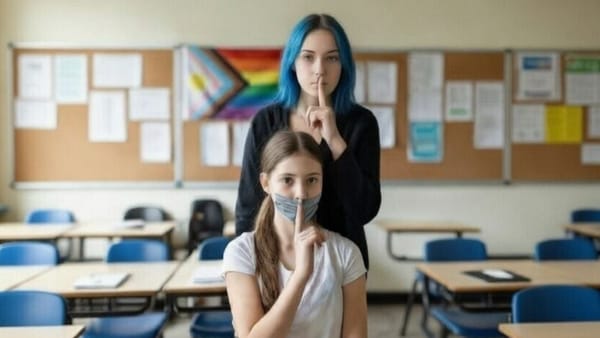
In December 2022, Amber Lavigne found chest binders in her 13-year-old daughter's room.
She hadn't bought them. Her daughter hadn't bought them. A school social worker at Great Salt Bay Community School in Newcastle, Maine had given them to her child — devices designed to flatten a female chest to appear male — and had been referring to her daughter by a different name and different pronouns for months.
Without telling Amber.
When Amber confronted school officials, she learned something worse than the original act. The social worker had told her daughter he wasn't going to tell her mother. And that she didn't have to either.
A school employee had instructed a 13-year-old girl to keep secrets from her mother about her own body.
The school board, when Amber appeared before them to speak, released a statement saying their first priority was providing a "safe, welcoming, and inclusive environment for all students." They said no policies had been violated. They renewed the social worker's contract.
Amber Lavigne withdrew her daughter from Great Salt Bay Community School. Then she sued.
The case moved through two levels of federal court. Both dismissed it.
Not because the conduct was found acceptable. Not because her parental rights were ruled unimportant. The courts dismissed the case on a procedural argument: Amber had not plausibly alleged that the Board had a formal, written policy of withholding information from parents. Because the school's written policies technically encouraged parental involvement, the courts concluded there was no evidence of an institutional policy — just the actions of individual employees the school board happened to defend, whose contracts the school board happened to renew, in a school operating under state guidelines the school board happened to adopt.
The result: no liability. No accountability. No day in court.
The Manhattan Institute recently filed an amicus brief asking the Supreme Court to review the case. Their argument cuts to something important beyond this case alone. Courts, they note, are increasingly dismissing lawsuits by inventing their own explanations for government behavior — crediting official denials over the lived experience of the people harmed. A complaint only needs to allege facts that make harm plausible, not certain. Discovery exists to sort out probability. When courts skip that step by constructing alternate explanations for the defendant, they make it nearly impossible to hold institutions accountable for anything they haven't written down in a policy manual.
That is a legal problem with consequences far beyond Maine. It means that any institution — a school board, a government agency, a bureaucracy of any kind — can behave in whatever way it chooses, so long as it is careful never to write it down. The unwritten policy is now the safest policy. The courts, in cases like this one, have made it so.
The school board of Great Salt Bay Community School did not invent this on their own. They were operating within a framework — Maine state law, school district guidelines, a culture of institutional confidence that comes from years of parents not being in the room when the decisions were made.
That is the pattern. Not a conspiracy. Not a coordinated agenda from a central command. A vacuum, filled gradually and deliberately by people who understood that the rooms where these decisions get made are largely unoccupied.
The social worker who gave a 13-year-old girl a chest binder and told her to hide it from her mother did not do so in a community where a Guardian was standing in the gap. He did it in a community where the school board had been making decisions for years without serious challenge, where the guidelines were adopted without parents present, and where the culture of the institution had drifted far enough from the families it served that this seemed — to someone — like an acceptable thing to do.
That is the cost of absence. Not malice on your part. Just vacancy.
Amber Lavigne showed up. She went to the school board meeting. She spoke. She filed the lawsuit. She did what a Guardian does — she entered the room and refused to be silent. The courts failed her. But her faithfulness in that moment mattered, and it is not finished. The case is now before the Supreme Court.
The question for every Guardian reading this is not what you think about what happened in Maine. The question is what school board, in what district, in what community near you is making decisions right now in rooms you have not entered.
This case is not primarily about gender ideology. It is about who holds authority over children — parents or institutions. That question is being answered right now, in school districts across the country, in meetings that most parents never attend.
The church has members in nearly every school district in America. The moral majority is not a myth. It is a sleeping reality. And sleeping realities do not protect 13-year-old girls from being told to keep secrets from their mothers.
From a Guardian's perspective, this is a signal: the school board is a mission field. Show up before you have to.
Find the next meeting of your local school board. Put it on your calendar. Show up. You don't need a role, a platform, or a coalition. You need to be in the room.
The room is not waiting for you to arrive perfectly equipped. It is waiting for someone who cares enough to show up at all.
The Case Against the Sexual Revolution — Louise Perry. A clear-eyed examination of how progressive ideology around sex and gender has harmed women and children — and what a recovery rooted in reality looks like.
Irreversible Damage — Abigail Shrier. The most thorough investigation available into the social contagion of gender dysphoria among adolescent girls, the institutions promoting it, and the parents left to fight alone.
Parental Rights Foundation — parentalrights.org.. The leading national organization working to enshrine parental rights in constitutional law. Know the legal landscape before you need it.