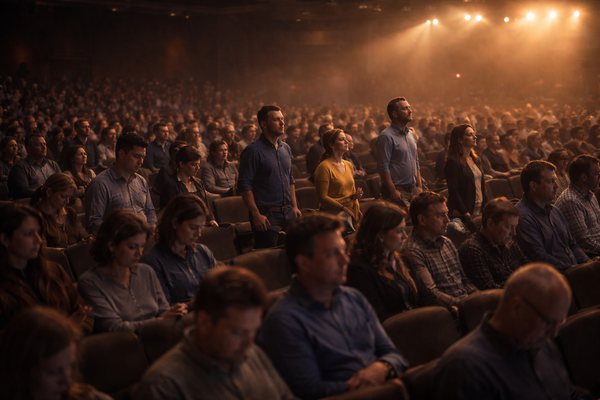
They're Coming Back to Church. But Are They Being Formed?
Church attendance is up. Bible sales are surging. And yet the latest research finds that just 4% of American adults hold a biblical worldview — and among Gen Z, it's 1%. More people in the pews. The same vacancy in the culture. This isn't a revival. It's a waiting room.
In the months following the death of Charlie Kirk, something stirred in the American church. Church attendance rose. Bible sales climbed. Public conversation about faith intensified. It looked, to many observers, like the early signs of something significant.
Then George Barna released the data.
The American Worldview Inventory 2026 — conducted in January by Arizona Christian University's Cultural Research Center and based on 53 questions asked of 2,000 American adults — delivered a finding that should stop every pastor, parent, and believer cold. Biblical worldview in America has not increased. It remains stalled at 4% overall — and among Gen Z, the incidence drops to just 1%. A CROOKED PATH
More people in church. The same vacancy in the culture. The same drift in the pews.
Why It Matters
A quarter century ago, 12% of the adult population held a biblical worldview. Since then there has been a steady reduction — reaching a low point of 4% in 2023, and it has not recovered.
This decline is visible within the church itself. Only 11% of adults attending evangelical Protestant churches have a biblical worldview — down from 21% in 2020. Among theologically-defined, born-again Christians, just 12% hold one, compared to 19% in 2020.
Read that again slowly. Among people who show up every Sunday, confess Christ, sing the hymns, and call themselves born-again — nearly nine out of ten do not think, decide, and live according to a biblical framework.
The pews are not empty. The formation is.
This matters because a worldview is not an opinion. It is the intellectual, emotional, and spiritual filter through which we interpret reality — and it becomes the basis of every decision we make. A person without a formed biblical worldview does not simply believe differently about abstract theological questions. They make different decisions about their marriage, their children, their workplace, their vote, their silence, and their courage. They go into the world shaped by whatever else formed them — and in 2026, that means shaped by a culture that has been working overtime.
What's Really Going On
The easy read on this data is that the church has a teaching problem. That's true — but it's only part of the picture.
Between 2023 and 2025, the percentage of churchgoers who believe the Bible offers clear and decisive teaching on five contemporary social issues dropped sharply — including marriage (down 10%), homosexuality (down 16%), transgenderism (down 12%), religious liberty (down 10%), and abortion (down 14%). The Washington Stand
These are people in the building. Regularly. And the culture is winning the formation battle while they sit in the chairs.
Barna's assessment is pointed: "People may go to church, but it doesn't seem like they're coming out with anything that's moving them either toward a biblical worldview or toward biblical discipleship."
The problem is not primarily attendance. It is formation — the slow, sustained, intentional work of shaping how a person sees the world. And most American churches, for reasons that are complex and largely not malicious, are not doing it. Research has found that sin is rarely talked about in sermons, featuring in only 3% of sermons in a given year, because pastors "don't want to deal with those things" — and what gets offered instead is more often self-help than discipleship.
A person shaped by self-help does not stand in the gap. They manage their feelings about the gap.
This is not a crisis of belief. Most of the people sitting in those pews would tell you they believe the Bible is true. The problem is that the typical American adult is not a worldview purist but essentially a worldview plagiarist — combining beliefs and behaviors borrowed from an average of nine recognized worldviews into a personal blend. A little Scripture. A little therapy culture. A little postmodernism. A little nationalism. Stitched together into something that feels coherent until the pressure comes — and then it comes apart.
You cannot carry a Cross you were never trained to hold.
The Guardian's Lens
This week's Crucible opened with a pattern: institutions that bear a name but have lost the mission. Christian colleges directing students toward the abortion industry. School boards quietly filling the vacuum left by absent parents. The mechanism in every case is the same — organized presence meeting organized absence.
The Barna data tells us that mechanism is operating inside the church itself.
The people are returning. The interest is real. The hunger is genuine. But interest without formation does not produce Guardians. It produces enthusiastic spectators — people who feel something on Sunday and return to the same patterns on Monday because no one ever gave them a different set of habits, convictions, and tools.
Two realities can coexist: spiritual openness can rise while key markers of Christian conviction remain flat. That is exactly what the data shows. And it is precisely why formation cannot be left to accident, sentiment, or the assumption that showing up is enough.
The answer is not despair. It is not another program. It is not louder preaching or better music or a new sermon series.
It is the slow, costly, unglamorous work of forming people — in Scripture, in community, in the daily practice of carrying conviction outward into the world. Worldview is not downloaded in a service. People begin forming their worldview very early in life, establish it before their teen years, then refine it throughout their 20s. Which means the church that waits until Sunday morning to do formation work is decades behind the culture that has been doing it every other hour of every other day.
This is the moment. Not for another revival rally. For formation that holds.
Carry the Cross
Primary action: Have an honest conversation about formation — not attendance — at your church. Ask your pastor directly: what is our plan for equipping people to think and live biblically, not just show up? You don't need to be combative. You need to be present, specific, and willing to stay in the conversation.
Three supporting moves:
Look up your church's approach to discipleship. Does it exist as a defined pathway — or is it assumed to happen through osmosis?
Share this article with one person in your congregation who you know is hungry for more than Sunday morning provides.
A church full of half-formed believers is not a revival. It is a waiting room. The people sitting in those chairs are not the problem — they are the mission field and the opportunity simultaneously. The question is whether the church will rise to the formation challenge before the culture finishes the job it has been doing for thirty years. Guardians don't wait for institutions to lead. They lead within them. Start this Sunday.
Want to Go Deeper?
Revolutionary Parenting — George Barna. If worldview is formed before the teen years, then the home is the primary formation institution — not the church. Barna's research on what actually produces spiritually resilient children.
Mere Christianity — C.S. Lewis. The book that has formed more biblical worldviews outside a formal church context than perhaps any other in the last century. If someone in your life is returning to faith and hungry for substance — start here.
The Guardians' Cross
You were made for more than you've been living.
TGC is a formation movement for men and women who are done watching from the sidelines.
We equip Guardians to carry the Cross into every sphere of American culture —
with courage, conviction, and the full armor of God.