What He Left Behind
What a Georgia teacher left behind wasn't in his lesson plans. It was in how his family responded when the worst night of their lives became the most public.

– 4 min read

What a Georgia teacher left behind wasn't in his lesson plans. It was in how his family responded when the worst night of their lives became the most public.
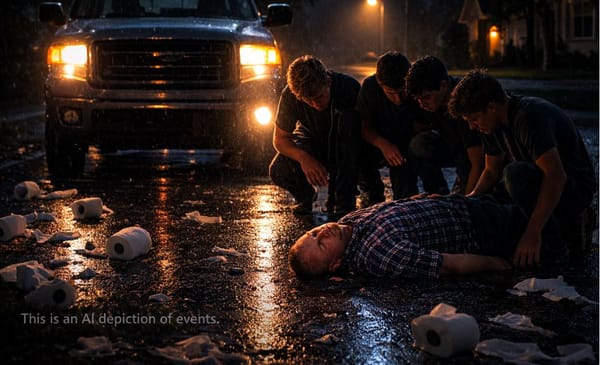
Late on a Friday night in Gainesville, Georgia, a group of teenagers pulled up to a teacher's house with rolls of toilet paper. It was a senior prank — a tradition at North Hall High School. The teacher knew they were coming. He was waiting to catch them. He came out of the house, slipped on the wet ground, fell into the road, and was struck by the pickup truck as the students drove away.
Jason Hughes was forty years old. He died at Northeast Georgia Medical Center later that night.
Within days, his wife issued a statement asking the public to show mercy to the teenagers involved. His family urged the district attorney to drop all charges. The eighteen-year-old driver, now facing up to fifteen years in prison for vehicular homicide, released a statement of his own: he pledged to spend the rest of his life honoring Jason Hughes by exemplifying Christ.
Something happened in Gainesville last week that the culture doesn't have a category for.
On the evening of March 6, Jayden Ryan Wallace and four other students arrived at Hughes' home off North Gate Drive to carry out what had become something of a North Hall tradition — rolling a teacher's yard. Hughes had apparently learned about the prank in advance and was looking forward to surprising them. It was the kind of moment that says everything about a man: he wasn't defending his property. He was participating in something he loved about his students.
When the teenagers spotted him and drove away, Hughes slipped in the rain and fell into the road. Wallace's truck struck him. The students stopped immediately and stayed with Hughes until emergency responders arrived. He was taken to the hospital, where he died.
Hall County Sheriff's deputies charged Wallace with first-degree vehicular homicide and reckless driving. The other four students were charged with criminal trespass and littering.
Then Jason Hughes' family did something that stopped the story.
His wife, Laura, clarified publicly that there had been no confrontation — that Jason knew these students, loved them, and was excited to catch them. His family asked for charges against all five to be dropped. They called it consistent with everything Jason had stood for. His football coach colleague, Sean Pender, described Hughes as a man of deep faith who ran a weekly Bible study for other coaches — someone who, as Pender put it, never judged, never forced anything, simply loved people well and met them where they were.
There is a version of this story the culture knows how to tell. Grieving family. Teenage recklessness. Justice demanded. A community's anger looking for somewhere to land.
That story didn't happen.
What happened instead is harder to explain in the terms most public discourse runs on. A family chose to absorb an unbearable loss and redirect it — not into vengeance, but into a declaration about what their husband and father believed. They looked at five teenagers whose lives hung in the balance and decided that protecting them was the most faithful thing they could do with their grief.
That decision came from somewhere. It didn't come from a grief counselor. It didn't come from a PR strategy. It came from decades of a man quietly shaping everyone around him with something most people in public life are reluctant to name plainly: the love of Christ, worked outward into a school, a family, a neighborhood, and five teenagers he was fully prepared to forgive before he ever knew he'd need to.
We have a tendency to look for the formed life in the big moments — the press conferences, the lawsuits, the viral stands. We wait for someone to carry their faith into a microphone.
Jason Hughes carried his faith into a Tuesday morning. Into a film room. Into a Bible study no one outside his school would ever hear about. Into a front yard on a rainy Friday night where he was waiting, not to confront, but to connect.
That is the thing that produced what his family did after he died. Formation doesn't perform. It doesn't announce itself. It simply shows up — in the choices made at midnight, in the mercy extended without an audience, in the way a man leads a weekly Bible study for coaches who may or may not believe what he believes, because he doesn't judge, he doesn't force, he simply loves people where they are.
The culture saw the Hughes family's statement and called it remarkable. It is. But it is not mysterious. It is the logical outcome of a life lived with conviction that ran deeper than circumstance. The family did not summon extraordinary grace from some reserve. They were already formed by it. So was the eighteen-year-old driver who, in the worst moment of his life, found something to hold onto that Jason Hughes had apparently modeled for him without ever making it a project.
This is what the formed life produces. Not headlines. Fruit.
You don't know what moment will require the most of you. Neither did Jason Hughes.
What you do know is that the reserves you will draw from in that moment are being built right now — in the ordinary, unremarkable, unobserved choices you make about how to treat the people in your life. Whether you judge or meet. Whether you push or stay. Whether your faith is something you explain or something you embody.
The Hughes family didn't improvise grace. They lived it into existence over years. So did Jason.
The question this week isn't whether you're ready for the extraordinary. It's whether you're showing up faithfully in the ordinary — in your home, your workplace, your school, your neighborhood — in ways that will matter when the extraordinary arrives.
That's the only formation that holds.
Learn more about The Guardians' Cross → theguardianscross.org