When Corporations Rebrand Conviction: Disney's Calculated Retreat
Disney is scrubbing DEI language from its filings and bleeding hundreds of millions at the box office. Don't mistake financial pressure for repentance. Guardians should know the difference.
They didn't change their minds. They changed their margins.
After years of ideologically driven decisions that cost them dearly at the box office and in the boardroom, Disney is quietly repositioning. DEI language is disappearing from official filings. Diversity programs are being scrubbed. The press is calling it a pivot. Guardians should call it what it is — a corporation doing the math, not examining its conscience.
The Story in Plain Terms
The numbers are hard to ignore. Disney's 2025 live-action Snow White remake lost an estimated $168 million — one of the largest single-film financial disasters in Hollywood history. That followed The Marvels and Indiana Jones and the Dial of Destiny in 2024, a one-two punch that cost the company nearly $900 million in potential revenue. Years of ideologically driven storytelling had finally produced a bill that even the most committed boardroom could not explain away.
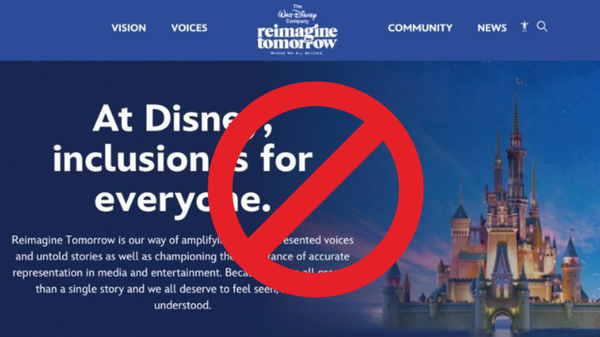
The response was swift — and telling. Disney removed the terms "diversity," "inclusion," and "DEI" from its annual business report for the first time since 2019. Its "Reimagine Tomorrow" initiative — the program whose executive producer famously boasted about her "not-at-all-secret gay agenda" in Disney animation — was quietly scrubbed from SEC filings. The language of ideology was replaced with the language of business fundamentals.
What the headlines missed: this retreat didn't happen in a vacuum. America First Legal (AFL) had been pursuing Disney through legal channels for three years. In April 2022, AFL sent a formal letter to Disney's CEO and Board challenging its DEI practices as potential violations of federal law and a waste of corporate assets. In February 2024, AFL filed a civil rights complaint with the EEOC requesting a full investigation into Disney's diversity programs — arguing that policies requiring racial and sex-based quotas across Marvel, Hulu, ABC Entertainment, National Geographic, Lucasfilm, and others violated Title VII of the Civil Rights Act. One month later, AFL notified Disney's Board directly of the legal and shareholder risks. When Disney finally shut down "Reimagine Tomorrow" and eliminated the targeted programs, AFL called it exactly what it was: a victory. Not a change of heart — a legal surrender. The box office losses weakened Disney's resolve. The legal pressure broke it.
And here is where it gets even more instructive for Guardians: while Disney was stripping DEI language from its filings, it was simultaneously flooding Disney+ with R-rated and TV-MA content from its Hulu acquisition. One analyst estimated a 2,000 percent increase in R-rated titles on the platform. The ideology didn't leave. It just stopped announcing itself.
Why It Matters
This matters because it touches faith, discernment, and the integrity of how we engage a culture that has learned to speak our language without sharing our values.
The question this raises is not whether Disney made bad movies. They did. The question is this: when a corporation that spent years actively working against your values comes back to court your dollars — do you know how to read what's actually happening?
What We See as Guardians
Let's be precise about what Disney actually did.
They did not repent. They did not change leadership values, institutional culture, creative priorities, or the content pipeline flowing into millions of homes through Disney+. What they changed was the language in their SEC filings — language that had become a liability with investors, regulators, and federal courts in a shifting political climate. The removal of "DEI" from a federal disclosure document is a legal and financial decision. It is not a moral one.
This pattern is not new. Bud Light spent months in damage control after its 2023 campaign collapse, made conciliatory gestures, and resumed business as usual the moment the quarterly pressure eased. The NFL knelt — figuratively and literally — and waited for the outrage cycle to pass. Corporations do not change their convictions under financial pressure. They change their marketing.
What makes Disney's move particularly instructive is the simultaneity of it. In the same season they were stripping DEI language from filings, they were adding thousands of hours of adult content to a platform that was built — and sold to families — on the promise of being safe. The right hand was performing the retreat. The left hand was expanding the advance. Guardians who were watching closely saw both moves. Those who were only watching the headlines saw a story of corporate repentance that was never actually there.
The Guardian's Lens
Here is what a Guardian understands that a casual consumer might miss: institutions reveal their values through their patterns, not their press releases.
Disney's pattern over the past decade is documented. The content choices. The executive statements. The programs they built and funded. The battles they picked — including a very public fight with the state of Florida over parental rights in education. None of that was accidental. It was institutional conviction, expressed through a position of cultural power.
The AFL campaign is worth noting here not as a political endorsement but as a model of engagement. Three years of documented, legal, principled pressure produced a concrete result. Disney did not retreat because consumers got angry. It retreated because organized, persistent, lawfully applied pressure made the cost of staying the course exceed the cost of backing down. Financial losses opened the door. Legal accountability pushed Disney through it.
Financial losses don't erase institutional conviction. They temporarily suppress its expression. When the pressure eases — when the quarterly numbers stabilize, when the political climate shifts again, when the culture moves — those convictions will resurface. They always do. Because they were never really gone.
From a Guardian's perspective, this is a discernment test: Can you tell the difference between a corporation that found its conscience and a corporation that found its losses?
Carry the Cross
Guardians are not called to boycott everything or maintain an approved list of acceptable corporations. That path leads to exhaustion. But Guardians are called to think — clearly, deliberately, without being manipulated by a press release or a scrubbed filing.
Primary action: Before celebrating any corporate "pivot" toward your values, give it twelve months. Watch what the institution actually produces. Watch where the money actually flows. Watch whether the pattern changes — not just the language.
Support:
Actively seek out and support independent creators, studios, and media organizations that hold these values year-round — not when the earnings reports are bad
Have a conversation with your family about what you're funding when you fund entertainment — and make that a regular discipline, not a one-time decision
If you want to understand how organized legal pressure actually works against corporate overreach, learn what America First Legal accomplished here — and consider what similar engagement could look like in your sphere
A Closing Charge
The culture is not changed by consumers who can be won back with a rebranded filing. It is changed by Guardians who are paying attention — who hold the line long enough, and think clearly enough, to know the difference between a retreat and a surrender.
Disney retreated. It has not surrendered its vision for your family's imagination.