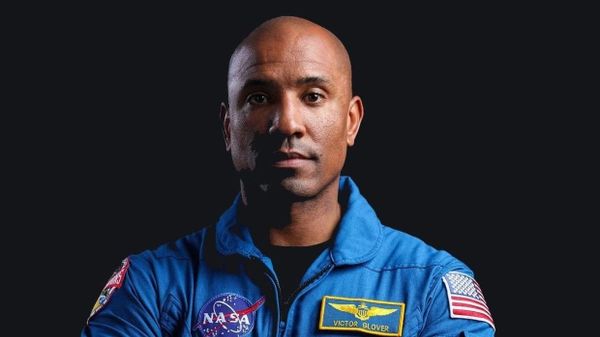
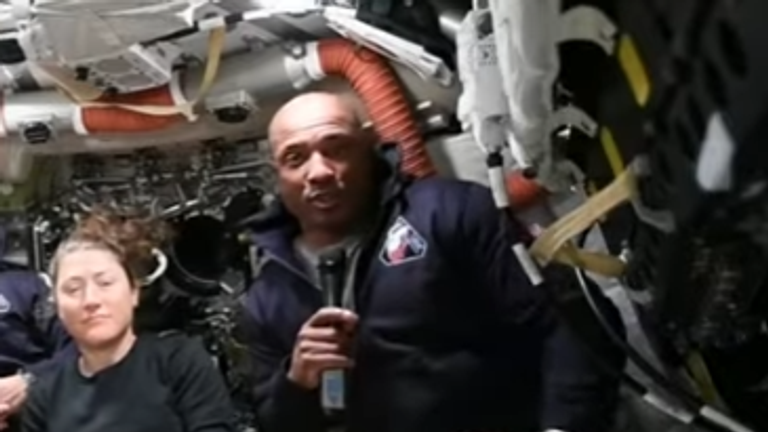
Today four astronauts are flying around the moon for the first time in over fifty years. One of them brought his Bible. On the Monday after Easter, that is worth more than a passing glance.
Today, Monday April 6, 2026, four astronauts are making their closest approach to the moon.
They launched five days ago from Kennedy Space Center on April 1 — the first crewed lunar mission since Apollo 17 in December 1972. Commander Reid Wiseman, Pilot Victor Glover, Mission Specialist Christina Koch, and Canadian astronaut Jeremy Hansen are traveling farther from Earth than any human beings have ever traveled: an estimated 252,799 miles from home, breaking the record set by Apollo 13. Today they fly around the far side of the moon. Some of what they will see, no human eyes have ever seen.
One of them brought a Bible.
The Story
Victor Glover is a United States Navy captain, a test pilot with 3,000 flight hours in more than 40 aircraft, and the pilot of the Artemis II mission. He is also a committed Christian and a member of the Southeast Church of Christ in Friendswood, Texas — six miles from NASA's Space Center Houston.
This is not the first time Glover has taken his faith into space. During his 2020-21 mission to the International Space Station, he brought a Bible and communion cups and took communion weekly. He streamed worship services from his home church while orbiting 250 miles above Earth. When he looked out the window at Earth rising in the darkness, he posted the words of Psalm 30: "Weeping may endure for a night, but joy cometh in the morning."
In a 2023 interview with the Christian Chronicle, Glover described how his faith, his military career, and his scientific work are "interwoven." He said his career is fed by his faith — that before every flight, without exception, he prays. When asked about working at NASA, where conversations about the solar system are commonplace, he said he regularly refers to "the beauty of creation" — and that the word lands the same way in both settings. "That's in church and at NASA," he said. Asked directly whether faith and science conflict, he was clear: "I believe in both, and I don't find them to be in conflict."
Before the Artemis II launch, when reporters pressed him on what it means to be the first person of color to travel to the vicinity of the moon, Glover gave an answer that cut against the expected narrative. "I love that," he said, "but I also hope we are pushing the other direction — that this is just human history. It's the story of humanity — not black history, not women's history."
On Easter Sunday, April 5, with the moon filling the window of the Orion capsule, NASA asked Glover if he had any message for the people on Earth observing the holiday. He did not prepare remarks. He looked back at the planet he had left behind and said: "As we are so far from earth and looking back at the beauty of creation — you're on a spaceship called Earth that was created to give us a place to live in the universe. I'm trying to tell you, just trust me: you are special."
What It Reveals
Victor Glover is not an anomaly. He is a reminder of something the culture has spent decades trying to treat as impossible: a person for whom rigorous scientific training and sincere Christian faith are not in tension but integrated — two ways of engaging the same reality, pointing in the same direction.
The dominant cultural narrative insists that faith and science are at war — that a serious scientist cannot hold serious theological convictions, and that a serious believer must distrust the conclusions of careful inquiry. Glover's life is a standing refutation of that narrative. He has accumulated 3,000 flight hours, commanded spacewalks, and piloted the first crewed mission beyond Earth orbit in fifty years — and he prays before every flight, takes communion in orbit, and reads his Bible at NASA.
There is also the identity politics moment worth sitting with. Glover was handed the narrative the culture expected him to accept — historic black achievement, milestone representation — and he received it graciously and then redirected it toward something larger. Not black history. Human history. The story of all of us. That is not a rejection of his identity. It is a refusal to be reduced to it.
The Frame
The week after Easter, four human beings are flying around the moon.
The timing is not incidental. Easter is the claim that death is not the final word — that the story is not over when the stone rolls into place, that what appears to be the end is in fact the beginning of something no one anticipated. Artemis II is, in its own register, a version of the same claim: that the story of human exploration did not end in 1972, that the silence of fifty years was not a conclusion but a pause, and that going farther is still possible.
Glover's Easter message from space named the connection without forcing it. Looking back at Earth from a quarter-million miles away, he told the people watching from the ground that they were the ones sitting on something extraordinary. "You're on a spaceship called Earth that was created to give us a place to live in the universe." Creation is not background. It is the point. The cosmos is not empty — it is inhabited, purposefully, by creatures made in the image of the one who made it.
The men of Issachar understood the times. A Guardian who looks up this week and sees four people flying around the moon — one of them carrying a Bible and a theology that holds together what the culture insists must come apart — is looking at something worth understanding.
What It Asks
Glover said his career is fed by his faith. Not complicated by it. Not survived despite it. Fed by it.
That is the formation question for this Monday. Not whether faith and science can coexist in theory — Glover answered that from orbit on Easter Sunday. But whether the person reading this has built a life in which what they believe and what they do are genuinely integrated — or whether faith is something that runs parallel to the rest of life without ever actually touching it.
A formed person carries what they believe into every room they enter. The cockpit. The laboratory. The boardroom. The press conference where the expected narrative is waiting. Glover did not leave his faith on the launchpad. He took it to the moon.
The question is where you are leaving yours.
Further Reading
Christian Chronicle — "Christian astronaut pilots first moon mission in 53 years" — The most complete profile of Glover's faith and church community. Read here →
Evangelical Focus — "Artemis II astronaut Victor Glover: I pray that God will bless this mission" — Glover's pre-launch interview including his call for Christians worldwide to pray. Read here →
National Catholic Register — "Returning to the Moon, Returning to God" — On the theological thread running from Apollo 8's Genesis reading through Glover's Artemis II mission. Read here →