The Moment
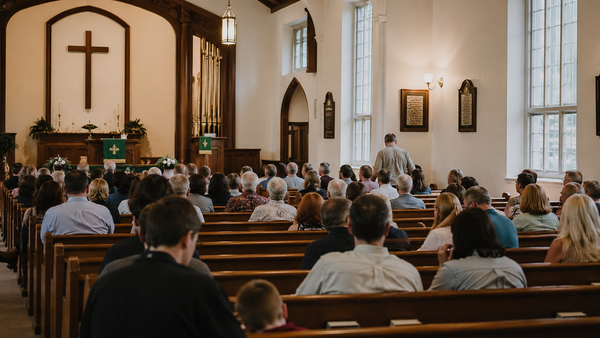
Median in-person weekly worship attendance in the U.S. is the highest it's been since before the COVID-19 lockdowns. The median congregation grew from 65 worshippers in 2020 to 70 today. The study draws on surveys from 7,453 congregations.
"What we're seeing is not a revival — it's a recalibration," said Alison Norton, co-investigator on the project. "Congregations have been through an extraordinary period of disruption, and though it has taken a while, many have come out of it with greater clarity about who they are and what they're called to do."
This is the first positive gain in median attendance in 25 years. Crosswalk
The Story
The American church-decline narrative has been one of the most consistent stories in mainstream media for two decades. The Hartford Institute data does not erase any of that. The median congregation is still roughly half the size it was in 2000. Nearly half of all congregations still report declining attendance.
But something has shifted.
Financial giving has recovered beyond expectations, volunteer engagement and programming have largely rebounded, and clergy have reported improved well-being. Fewer clergy are thinking about leaving the ministry.
Gen Z is adding complexity. Recent Barna survey data shows Gen Z reports the highest weekly church attendance of any adult generation, slightly ahead of Millennials. At the same time, Gen Z is more likely to remain religiously unaffiliated — reflecting skepticism toward institutions rather than a rejection of faith itself.
And the gender attendance gap — which has favored women for decades — has narrowed. Men now report slightly higher weekly church attendance than women, reversing a long-standing trend.
What It Reveals
The data suggests a sorting. The congregations that survived the pandemic and came out with greater clarity about their mission are growing. The ones that were already unclear about their purpose are still shrinking. The pandemic did not cause the decline of the unclear congregations — it accelerated a process already underway. And it did something unexpected for the clear ones: it forced a focus now showing up in the attendance numbers.
The churches that are growing know what they are for. They know what they believe. They held their mission under pressure and came out more defined, not less. The Barna Group reported separately that 66% of American adults now claim a meaningful personal commitment to Jesus — up 12 points since 2021. Bible sales are up 41% since 2022. Campus worship movements this month drew tens of thousands of students to worship nights at party schools.
The story is more complicated than either the decline narrative or the revival narrative. People are hungry. Some are finding what they are looking for. The church that knows who it is and what it carries is positioned for exactly this moment.
The Frame
The institutions growing in this environment share a common characteristic: they have not tried to become more palatable to a skeptical culture by softening what they hold. They have become more defined. The Great Awakenings did not produce growth by making the faith easier to hold. They produced growth by making it more urgent, more specific, and more demanding. The churches growing today understood this before the pandemic — and held it through the pressure.
The press will continue to run the decline narrative because the long-term numbers still support it as the frame. But the people paying close attention know the trajectory has shifted — and that the shift is explained not by cultural tailwinds, but by clarity.
What It Asks
For anyone part of a local church: the data is not a reason for complacency. It is a reason for clarity. The question worth asking of your own community is not whether attendance is up — it is whether the clarity is there.
For anyone watching the church from the outside: the story you have been told is incomplete. Something is happening in the congregations that held their mission under pressure. It is worth paying attention to.
The institutions that survive disruption are the ones that know what they are for before the disruption arrives. The congregations coming out of this pressure with growing attendance are not the ones that softened their convictions to become more accessible. They are the ones that became more clear. That is not a religious observation. It is an organizational one. A community that knows its mission and holds it under fire is more durable than one that drifts toward consensus. The data is beginning to show which kind of church the American landscape is actually producing.
Learn more at theguardianscross.org
Further Reading
- Hartford Institute — EPIC Project — The primary source. 7,453 congregations, full attendance data and findings. Visit here →
- Religion News Service — "Worship Attendance at Churches Up for the First Time in Decades" — Most complete mainstream account with researcher quotes. Read here →
- NPR — "Study: In-Person Worship Attendance in U.S. Rises for First Time in Decades" — Key researcher quotes on what drove the shift and what it does and does not mean. Read here →