The Organization That Judged Everyone Else Just Got Indicted
The SPLC spent decades labeling Christian organizations as hate groups. Federal agencies, corporations, and platforms followed its lead. Last Tuesday it was indicted for fraud. The authority it wielded was borrowed — and it always was.
On April 21, 2026, a federal grand jury in Montgomery, Alabama, returned an 11-count indictment against the Southern Poverty Law Center, charging it with wire fraud, false statements to a federally insured bank, and conspiracy to commit money laundering. Coeur d'Alene Press
The core allegation: between 2014 and 2023, the SPLC secretly funneled more than $3 million in donated funds to individuals associated with violent extremist groups including the Ku Klux Klan, Aryan Nations, and the National Socialist Party of America. Coeur d'Alene Press The Justice Department alleges the SPLC defrauded donors by using their money to fund the very extremism it claimed to be fighting.
The SPLC has denied the allegations and says it will vigorously defend itself. The case will proceed through the courts. The legal outcome is not yet determined.
But the indictment — whatever its ultimate result — opens a question worth examining: what kind of authority did the SPLC actually have, and how did it get it?
The Story
The Southern Poverty Law Center was founded in 1971 as a civil rights legal clinic. By the 1990s it had pivoted to identifying and cataloguing hate groups across the United States through its "Hatewatch" project. That list became one of the most consequential instruments of institutional power in American civil society.
An internal FBI system contained at least 13 documents that cited SPLC material, including the Richmond memorandum that labeled traditional Catholics as "violent extremists." The Justice Department also scheduled regular meetings with the SPLC, gave it early access to federal law-enforcement data, and allowed SPLC employees to train federal prosecutors. Religion Media Centre
The SPLC's hate group list included organizations that hold historic Christian positions on human sexuality, marriage, and gender. Alliance Defending Freedom, the Family Research Council, and the American Family Association have all appeared on it. The designation was used to pressure payment processors, corporate donors, and media organizations to distance themselves from these groups. In some cases it succeeded.
The question the indictment raises is not whether the SPLC's legal defense will prevail. It is what it means that an organization with this much institutional reach was — according to a federal grand jury — secretly paying the leaders of the very groups it was publicly denouncing.
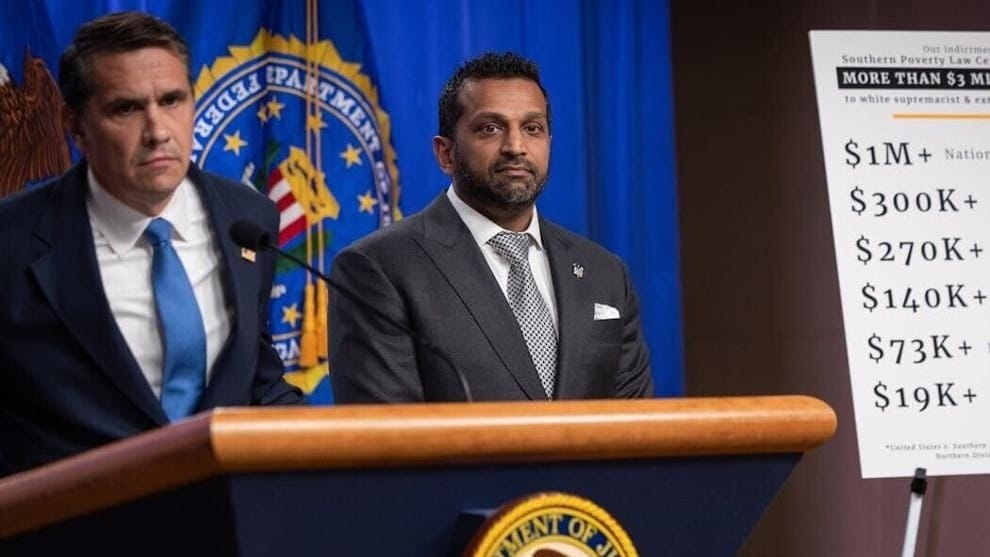
Acting U.S. Attorney General Todd Blanche speaks as FBI Director Kash Patel stands by during a press conference at the Department of Justice in Washington, D.C., April 21, 2026.
What It Reveals
The SPLC's authority over American institutional life was borrowed authority. It did not derive from democratic accountability, judicial oversight, or any formal mandate. It derived from the willingness of powerful institutions — corporations, platforms, federal agencies — to treat its designations as credible without independent verification.
This is how institutional authority works in practice. Organizations that claim the moral high ground and are not seriously challenged accumulate influence far beyond their actual accountability. The SPLC claimed to be a watchdog. Corporations and agencies used it as outsourced moral authority. Nobody asked the obvious questions: Who watches the watchdog? What are their standards? What recourse exists for organizations wrongly designated?
For years, the answers were: nobody, unclear, and none.
The indictment does not resolve those questions. But it makes them unavoidable in a way they were not before.
The Frame
Christian organizations that were labeled by the SPLC spent years arguing the designations were inaccurate, politically motivated, and methodologically flawed. They were largely ignored. The institutional architecture that had incorporated the SPLC's authority did not have a good mechanism for processing the objection.
The indictment does not vindicate those organizations' theological positions. It does something more limited and more important: it documents that the institution claiming authority to judge them was not what it claimed to be.
The lesson is not that Christian organizations should celebrate a legal indictment. Legal indictments are serious and the outcome is uncertain. The lesson is that borrowed institutional authority is always more fragile than it appears. The SPLC's influence was always contingent on the willingness of institutions to accept its authority uncritically. That willingness is now harder to sustain.
What It Asks
For anyone who leads or belongs to a Christian organization that has been labeled, pressure-campaigned, or defunded based on SPLC designations: the institutions that used those designations as cover now face a more complicated situation.
That does not mean automatic vindication. It means the conversation has shifted. The organizations that know what they believe and why they believe it — that have held their positions with documented reasoning and without apology — are in a stronger position now than they were two weeks ago.
The formed person does not build their case on the collapse of their opponent. They build it on the clarity of what they actually hold. The indictment removes an obstacle. The obligation to carry the truth into the room remains unchanged.
The Guardian's Lens
Institutional authority that is never seriously questioned is not actually authority — it is leverage. The SPLC accumulated leverage by positioning itself as the arbiter of which organizations were acceptable and which were not, and the institutions that deferred to it never asked the accountability questions that legitimate authority requires. A free people governed by genuine accountability structures does not outsource its moral judgments to self-appointed watchdogs. The indictment is a reminder that clarity about what you actually believe, and the willingness to defend it on its merits, is a more durable foundation than institutional approval from organizations that may not be what they claim.