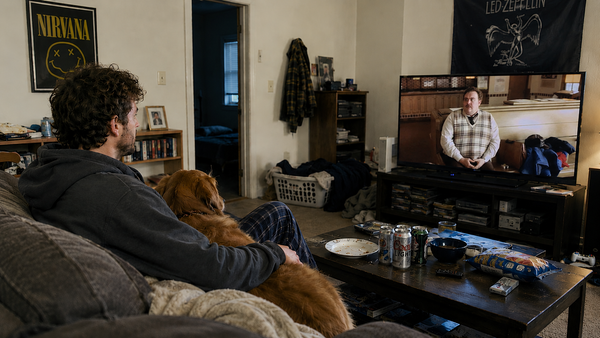
The Moment
In May 2023, U.S. Surgeon General Vivek Murthy released an 81-page advisory with a headline finding that should have stopped the country cold: approximately half of American adults were experiencing measurable levels of loneliness. Not occasional loneliness. Chronic, health-threatening isolation.
The report compared the mortality risk of loneliness to smoking fifteen cigarettes a day. It documented a 29% increased risk of heart disease, a 32% increased risk of stroke, and a 50% increased risk of dementia among chronically isolated older adults. It warned that young people aged 15 to 24 had 70% less in-person social interaction with friends than their counterparts two decades earlier.
That was three years ago. The advisory generated significant press coverage for several weeks. Then the news cycle moved on.
The numbers have not.
The Story
The loneliness epidemic did not begin with COVID-19, though the pandemic accelerated it. The Surgeon General's report documented a fifty-year decline in the social infrastructure that had historically kept Americans connected: participation in civic organizations, recreational leagues, service clubs, neighborhood associations, and local institutions of every kind dropped steadily from the 1970s onward.
For nearly half a century, we've seen declining participation in the organizations that used to bring us together — recreational leagues, service organizations, and faith organizations. Religion Media Centre
Robert Putnam documented this collapse in Bowling Alone (2000), which tracked the disappearance of social capital — the dense web of relationships and shared commitments that hold communities together. The trends he documented accelerated.
By the time the Surgeon General issued his advisory, the data was unambiguous. Americans were spending dramatically less time with friends, neighbors, and extended family than at any point in the previous half-century. The share of adults reporting no close friends at all had roughly tripled since 1990.
Three years after the advisory, the numbers have not moved. Harvard's Making Caring Common project found that 21% of adults reported serious feelings of loneliness, with adults aged 30-44 as the loneliest group at 29%. The $6.7 billion in additional Medicare spending attributable to social isolation each year continues to compound. Premier Christian News
What It Reveals
The persistence of the problem reveals something important about its nature: loneliness is not primarily a policy problem. It cannot be solved by a Surgeon General's advisory, a federal program, or a public awareness campaign.
Loneliness is a structural problem — produced by the systematic dismantling of the institutions that have historically kept human beings connected. It cannot be addressed without rebuilding them. Not simulating them. Rebuilding them.
This is where the proposed solutions tend to fall short. Technology companies have offered social platforms as a remedy, and the data consistently shows that heavy social media use correlates with increased loneliness. The AI companion market — 220 million downloads — is growing at 88% year-over-year, and a joint MIT-OpenAI study found that heavy daily use correlated with higher loneliness and lower real-world socialization.
The most effective way to connect with another human being is still in-person. Even calling someone on the phone or video conferencing can be powerful. The more you get closer to that in-person interaction, the more powerful it is. Religion Media Centre
The substitutes are not working because what they offer — availability without accountability, connection without cost — is not what the lonely person is actually missing.
The Frame
The Surgeon General's advisory included a section that received relatively little attention: a catalog of the institutions historically most effective at sustaining social connection. Local policymakers can support the creation of spaces where people can come together to share experiences of art, music, the outdoors, history, sports, culture and religion — the things that make us human. Korean Studies Institute
The fifty-year decline in civic participation maps almost exactly onto the fifty-year decline in religious participation. The two trends are not independent. They are the same trend: the collapse of the institutions that required Americans to show up, over time, for something beyond themselves.
The question the loneliness data ultimately raises is not how to treat loneliness as a symptom. It is how to rebuild the institutions that prevented it from becoming epidemic in the first place.
What It Asks
For anyone who leads, participates in, or is building a community of any kind — the loneliness data is not a social problem to be observed from a distance. It is a description of the people around you.
The person who eats lunch alone every day. The neighbor whose name you do not know. The young adult who moved to your city and has not found a community. The parent whose social world collapsed when their children left home. These are not statistics. They are the documented reality of half the adults in the country.
The institutions that reduced loneliness historically did not do so through programming or outreach. They did so by requiring people to show up — consistently, over time, for something that demanded something of them. That is not a feature that scales through an app or a federal advisory. It requires actual people deciding to build actual communities and invite actual neighbors into them.
The data has been clear for three years. The question is what gets built in response.
The Guardian's Lens
The loneliness epidemic is a structural problem, not a policy problem — and structural problems require structural solutions. The institutions that historically prevented this level of isolation shared a common feature: they demanded something from the people who belonged to them. Not just attendance, but commitment. Not just connection, but accountability. The communities rebuilding social infrastructure right now are the ones that understand this. They are not offering services. They are building the kind of place where people are known, expected, and missed when they do not show up. That is not a program. It is a decision about what kind of community to be.
Learn more at theguardianscross.org
Further Reading
- U.S. Surgeon General's Advisory — Our Epidemic of Loneliness and Isolation — 81 pages. The health data, the structural analysis, and the institutional recommendations. Read here →
- Bowling Alone — Robert Putnam (2000). The foundational account of social capital decline. The data that preceded the epidemic by two decades. Find it here →
- Harvard Making Caring Common — Loneliness in America — The most recent comprehensive survey data. Read here →
About The Guardians' Cross
The Guardians' Cross is a formation and cultural engagement ministry helping people carry their convictions into every area of public life. We publish The Guardian Standard three times a week — analysis that goes deeper than the headlines. If the ideas in this article resonate, there is more at theguardianscross.org.