The Name Changed. Nothing Else Did.
Harvard didn't dismantle DEI. It rebranded it — and quietly gave it more money. What looks like institutional surrender is something else entirely.

– 4 min read


Harvard didn't dismantle DEI. It rebranded it — and quietly gave it more money. What looks like institutional surrender is something else entirely.
The Moment
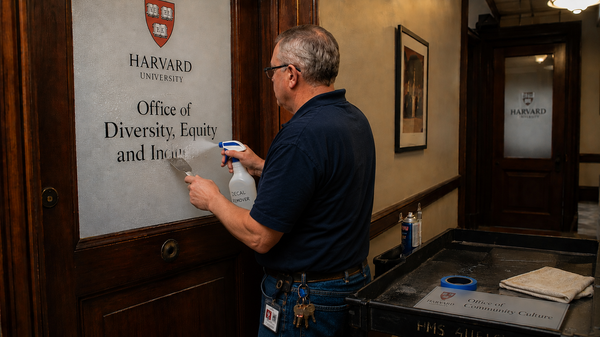
Sometime in the past twelve months, Harvard University removed the word "diversity" from its office names, scrubbed DEI language from its websites, closed three separate diversity offices, and announced a structural reorganization. The announcement looked, from a distance, like surrender.
It wasn't.
The Story
Under mounting pressure from the Trump administration — which froze billions in federal research funding and urged Harvard's accreditor to consider revoking the university's standing — Harvard moved quickly. The Women's Center, the BGLTQ Office, and the Harvard Foundation for Intercultural and Race Relations were consolidated into a newly created Office of Community Culture. The language on the new office's website emphasizes "intellectual and personal growth" and "everyone benefits when all are welcomed, supported, and included." The word "diversity" appears nowhere in the description.
Harvard Dean David Deming later confirmed to The Harvard Crimson that the new office holds more funding and more staff time than the three offices it replaced — combined.
The DEI programming did not end. It was absorbed, renamed, and expanded.
Meanwhile, Harvard's accrediting body, the New England Commission of Higher Education, proposed removing all explicit DEI references from its accreditation standards — not because the goals changed, but because retaining the language would force universities to choose between accreditor compliance and federal pressure. The solution was not to abandon the framework. It was to make the framework invisible.

What It Reveals
There is a pattern here that predates this moment and will outlast it.
Institutions rarely abandon their convictions under pressure. They protect them. The mechanism is always the same: change the vocabulary, preserve the substance, and wait for the pressure to pass. The convictions that couldn't survive public scrutiny get reclassified as administrative functions. The programs that drew criticism get reorganized under neutral-sounding names. The ideology doesn't move — only the label does.
This is not unique to Harvard or to this political moment. It is how durable institutions respond to external challenge. They compress. They go quiet. They rename. And when the pressure lifts, the substance re-emerges — usually with more resources than before.
What makes this moment instructive is not that Harvard did this. It is how openly it was confirmed. The dean said it directly: more funding, same staff time, same work. The rebranding was never meant to deceive — it was meant to survive. The institution was not ashamed of what it believed. It simply understood that what it believed could not, at that moment, be stated plainly.

The Frame
There is a word for the gap between what an institution says and what it does: it is called integrity. And its absence is not always malicious. Sometimes it is simply the oldest institutional reflex there is — protect the mission at the cost of the name.
But the cost of that reflex is never only reputational. When institutions learn that their core convictions must be hidden to survive, they are also learning something about the durability of those convictions. A belief that cannot be named in public is a belief that has already started to erode — not because the institution abandoned it, but because it agreed that the belief was something to be managed rather than held.
The question this moment surfaces is not whether Harvard's values were worth protecting. It is whether the way they were protected says something about the confidence behind them. Convictions that are genuinely held do not need new names. They need people willing to hold them when it costs something.
History is full of institutions — and individuals — who discovered too late that the habit of strategic rebranding, practiced long enough, produces people who no longer know what they actually believe.
What It Asks
Most people reading this are not running Harvard. But most people reading this have, at some point, found a quieter name for something they believed — in a meeting, in a conversation, in a relationship where the cost of clarity felt too high.
The question Harvard's moment puts to all of us is not political. It is personal. When your convictions meet real pressure — not theoretical pressure, not the pressure of an uncomfortable conversation, but the kind that has a dollar amount attached — what survives? The belief, or the label?
A person who knows what they actually stand for does not need a rebrand. They need only the willingness to hold the line with the same name they started with.
That is harder than it sounds. It is also the only kind of integrity that lasts.
The Guardian's Lens
Institutions reveal their true commitments not in what they announce but in what they protect when no one is supposed to be looking. Harvard's reorganization wasn't a retreat — it was a preservation strategy, and it worked. What it preserved was not just a program but a conviction that the institution was unwilling to publicly defend. The more durable question is not what Harvard renamed. It is what it would cost any of us to hold our own convictions under the same kind of pressure — without changing the label.
Learn more at theguardianscross.org.
About The Guardians' Cross
The Guardians' Cross is a formation and cultural engagement ministry helping people carry their convictions into every area of public life. We publish The Guardian Standard three times a week — analysis that goes deeper than the headlines. If the ideas in this article resonate, there is more at theguardianscross.org.