THE MOMENT
The U.S. Commission on Religious Liberty, established by President Trump in 2025, is tasked with issuing a report on the history and state of religious liberty in the nation by July 4, 2026 — the 250th anniversary of American independence. The report will address parental rights in religious education, school choice, conscience protections, attacks on houses of worship, free speech for religious entities, and institutional autonomy.
The same week that commission is preparing its findings, the Supreme Court issued one of the most significant First Amendment rulings in years. In Chiles v. Salazar, the Court struck down most applications of Colorado's ban on conversion therapy for minors in an 8-1 decision, ruling that the law violated the First Amendment when applied to counseling based solely on speech. Writing for the majority, Justice Neil Gorsuch said the state's law amounted to viewpoint discrimination because it permitted counselors to express one perspective on sexuality and gender identity but not another.
Two stories. One question underneath both of them. It is the same question the founders answered when they wrote the Bill of Rights — and the answer they gave is worth understanding before the 250th anniversary arrives in 29 days.
THE STORY
Most Americans think of the Bill of Rights as a list of freedoms the government gave them. Free speech. Free press. Free exercise of religion. The right to bear arms. Protection against unreasonable searches.
That is precisely backwards. And the confusion is not incidental — it goes to the heart of what the Bill of Rights is and why it matters whether Americans understand it correctly.
The Bill of Rights did not give Americans anything. It prohibited the government from taking what Americans already had.
The founders had spent the previous two weeks of the Constitution's drafting establishing a government of enumerated powers — a government that could only do what the Constitution specifically authorized. James Madison, who wrote the Bill of Rights, initially argued it was unnecessary precisely because of this design: if the government only has the powers the Constitution lists, it cannot infringe rights that aren't mentioned in any list of prohibitions.
He was eventually persuaded otherwise — not because the Constitution's structure was wrong, but because he recognized that future generations might forget the logic and read the Constitution as granting powers rather than limiting them. The Bill of Rights was added as an explicit guardrail: a set of specific prohibitions reminding every future government what it was never authorized to do in the first place.
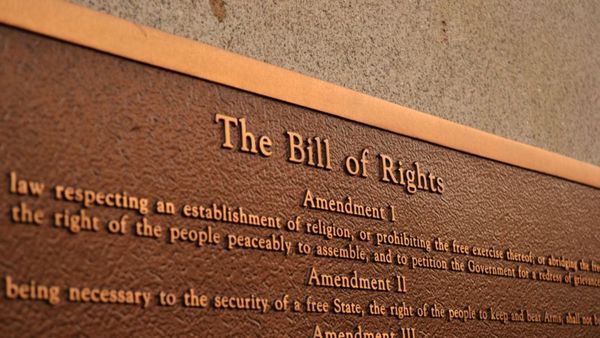
The first sixteen words of the Bill of Rights contain the two religious liberty clauses of the First Amendment: the Establishment Clause and the Free Exercise Clause. The first ten words comprise the Establishment Clause — "Congress shall make no law respecting an establishment of religion." The next six words — "or prohibiting the free exercise thereof" — comprise the Free Exercise Clause.
Congress shall make no law. Not: Congress may make limited laws. Not: Congress may make laws with sufficient justification. No law. The prohibition is absolute — and it was written that way deliberately, by men who had watched governments use religious establishment as a tool of political control and who intended to make that tool permanently unavailable to the American government.
WHAT IT REVEALS
The Chiles v. Salazar ruling is a clean illustration of what happens when the guardrail logic is forgotten.
Colorado did not claim it was establishing a state religion or directly prohibiting worship. It claimed it was regulating professional practice — telling licensed counselors what therapeutic approaches were permissible. The state's position was that it was not restricting speech; it was setting professional standards.
The Supreme Court disagreed 8-1. Justice Gorsuch's majority opinion held that Colorado's law amounted to viewpoint discrimination — it permitted counselors to express one perspective on sexuality and gender identity but prohibited another. The state was, in effect, using its licensing authority to control what thoughts a licensed professional could express in a confidential counseling session.
That is exactly the mechanism the First Amendment was designed to prevent. Not just censorship in the obvious sense — a government official seizing a printing press or arresting a preacher mid-sermon. The subtler and more dangerous form: the government using institutional authority to make certain ideas professionally or socially costly to express, while permitting the expression of competing ideas without penalty.
The founders called this tyranny. They had experienced it under the English establishment, where religious nonconformity carried professional and civil consequences even when it did not carry criminal ones. The Bill of Rights was not written to prevent only the most dramatic forms of government overreach. It was written to prevent the incremental, institutional, policy-dressed-as-professional-standard form that is far more common and far harder to name.
As one religious liberty advocate noted this week: the Founding Fathers understood that these were not rights granted by the government but fundamental rights granted to humanity by our Creator. The Bill of Rights does not create that truth. It acknowledges it — and warns every future government not to pretend otherwise.
THE FRAME
The religious liberty commission's report is due on July 4th. That deadline is not accidental. The administration that established it understood something worth stating plainly: the question of religious liberty is the founding question of the American experiment.
More than 400 years ago, a band of weary settlers set sail across the Atlantic on the Mayflower in search of religious liberty — setting in motion the most epic struggle for freedom and faith in the history of the world. The Pilgrims were not fleeing poverty or seeking adventure. They were fleeing a government that had made the practice of their faith professionally costly, socially marginal, and eventually illegal. They came to a new world to build communities where conscience could not be conscripted by the state.
That is the founding story. The Bill of Rights is its legal expression. And the cases before the Supreme Court this term — the counseling bans, the preschool exclusions, the Ten Commandments displays, the Johnson Amendment challenges — are not isolated First Amendment disputes. They are the same argument the Pilgrims were having with the English Crown in 1620, now being rehearsed in American courtrooms 406 years later.
The question in every case is the same: does the state have authority over conscience? The founders' answer was unambiguous. The Bill of Rights wrote that answer into law. What changes from generation to generation is not the answer but the willingness of citizens to understand it clearly enough to hold their government to it.
WHAT IT ASKS
Twenty-nine days from now the religious liberty commission will issue its report. The Supreme Court will hand down its remaining decisions. July 4th will arrive with fireworks and flags and ceremonies.
Before all of that — this week's ask is the simplest one in the America 250 series.
Read the First Amendment. All forty-five words of it. Read it not as a list of permissions the government extended to you but as a list of prohibitions the founders placed on the government to protect what already belonged to you. Read "Congress shall make no law" as what it is: an absolute. Not a guideline. Not a starting point for balancing tests. An absolute prohibition on a specific category of government action — the category that touches conscience, speech, press, assembly, and the right to petition.
Then ask yourself whether you have ever thought of your rights that way. Not as gifts. As guardrails. Things the government was explicitly forbidden from touching — because the founders understood that governments which are permitted to touch them will eventually eliminate them.
That understanding is what the Bill of Rights was written to preserve. Twenty-nine days remain to recover it before the anniversary of the document that made it official.
FURTHER READING
The Bill of Rights — Full Text — National Archives. Ten amendments. Read them as prohibitions on government, not permissions to citizens.
The Federalist No. 84 — Alexander Hamilton. Hamilton's original argument against the Bill of Rights — and the logic that makes Madison's decision to add it even more significant. Essential context.
THE GUARDIAN'S LENS
The Bill of Rights was not a gift from the government to the people. It was a fence the people built around the government — a written record of what the state was permanently forbidden from touching. Every generation that forgets this reads the Bill of Rights backwards: as a list of permissions rather than a list of prohibitions, as rights the government granted rather than rights the government is commanded to leave alone. The cases before the Supreme Court this term are not new arguments. They are the oldest argument in American history — the one the founders settled in 1791 and that every generation since has had to re-litigate because the settled answer keeps getting forgotten. Twenty-nine days. Learn more at theguardianscross.org.
About The Guardians' Cross The Guardians' Cross is a formation and cultural engagement ministry helping Americans reclaim their identity, their nation, and their destiny. We publish The American Guardian three times a week — analysis that goes deeper than the headlines. If the ideas in this article resonate, there is more at theguardianscross.org.