THE MOMENT
On July 4, 2026, America will celebrate 250 years of independence. The White House has named George Washington, John Adams, James Madison, Benjamin Franklin, and other American patriots as the founders who lit the torch of liberty in 1776.
That list is accurate as far as it goes. It does not go far enough.
America's semiquincentennial is a great time to celebrate all who helped make the country into what it is today — including some of the founding fathers who have not become household names over the last 250 years.
This week The American Guardian has looked at Washington — the man who refused power because he had been formed to understand what power does to the people who hold it. And Adams — the man who told the republic what it did not want to hear about what self-governance actually requires.
Today: three founders who shaped the ideas that produced both of them — and whose names most Americans do not know.
THE STORY
John Witherspoon — the man who taught Madison
John Witherspoon was the only clergyman both to sign the Declaration of Independence and to ratify the federal Constitution. During his tenure as president of the College of New Jersey at Princeton, Witherspoon became a mentor to James Madison and influenced many leaders and thinkers of the founding period. He was uniquely positioned at the crossroads of politics, religion, and education during the crucial first decades of the new republic.
Madison's theology had been largely shaped by the teachings of Witherspoon, whose strong biblical Calvinist faith included the doctrine of the natural depravity of man — the truth that was behind Madison's unique insistence on a government of checks and balances in which the innate sinfulness of men attaining power could be prevented from usurping total power.
Read that again. The separation of powers — the architectural principle that has defined American government for 250 years and that Monday's piece traced through Federalist No. 51 — did not originate with Madison as a political theory. It originated with Witherspoon as a theological conviction. Human beings are fallen. Power corrupts fallen people. Therefore power must be divided, checked, and limited — not because the founders were cynical, but because they were orthodox.
Witherspoon delivered a sermon titled "The Dominion of Providence over the Passions of Men" that justified the patriot cause on the basis of faith in God, tying Christian principles directly to the politics of revolution and inspiring many to use their faith to empower themselves to fight for independence.
He also, at the end of his life, called the New Jersey legislature to abolish slavery — following the same biblical logic that had animated everything else he built.
Roger Sherman — the man who made the Constitution possible
Roger Sherman of Connecticut is the only founder to sign all four of the republic's foundational documents: the Articles of Association of 1774, the Declaration of Independence, the Articles of Confederation, and the Constitution. He is also the architect of the Great Compromise of 1787 — the agreement that created the two-chamber Congress, giving small states equal representation in the Senate while proportioning the House to population. Without that compromise the Constitutional Convention would have collapsed. Without Sherman there would have been no compromise.
Sherman wrote in his personal confession of faith: "I believe that there is one only living and true God... and that the Scriptures of the Old and New Testament are a revelation from God." He helped draft the Doctrinal Creed of Yale. He was, in the founders' own assessment, one of the most practically capable men in the Continental Congress — the one who could be trusted to find workable solutions when ideological positions had hardened into deadlock.
Sherman understood something about republics that the more famous founders sometimes forgot in their eloquence: ideas require institutions to survive, and institutions require people willing to do the unglamorous work of making them function. The Constitution is not only a philosophical document. It is a practical one — and it exists because a Congregationalist shoemaker's son from Connecticut was willing to broker the compromise that no one else could.
Benjamin Rush — the man who understood formation
Benjamin Rush is among the founders for whom there is abundant evidence of embracing and articulating orthodox Christian ideas. He was a physician, a signer of the Declaration of Independence, and the most prolific founder on the subject of education and the formation of republican citizens.
Rush wrote in 1798 — the same year Adams wrote his letter to the Massachusetts Militia — that the Bible ought to be the primary textbook in American schools. Not because he wanted a theocracy. Because he understood that a republic requires citizens who are formed, and that the formation of citizens requires a source of moral authority that transcends the state. A government that tries to form citizens in its own image will eventually produce citizens who serve the government. A republic requires citizens who answer to something the government cannot reach.
Rush also founded the first free medical clinic in America, advocated for the abolition of slavery and capital punishment, and argued for the education of women at a time when that position was radical. His formation convictions were not abstract. They produced action.
He wrote: "The only foundation for a republic is to be laid in Religion. Without this there can be no virtue, and without virtue there can be no liberty, and liberty is the object and life of all republican governments."
That sentence is Adams in different words. It is Witherspoon applied to civic life. It is the founding consensus stated plainly by a man who signed the document that declared the republic into existence.
WHAT IT REVEALS
The formation that produced Washington and Adams was not accidental. It was systematic. It was transmitted through institutions — colleges, churches, communities — that were explicitly built to form citizens capable of self-governance.
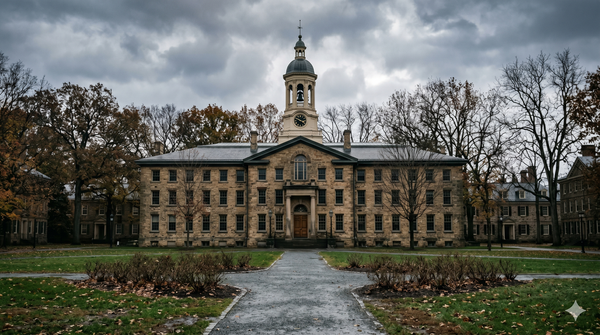
Witherspoon came to America in 1768 to become president of Princeton, which was founded in 1746 and was originally named the College of New Jersey. He was well-respected as an educator and taught many students who would go on to become influential judges and legislators, including James Madison.
Witherspoon taught Madison. Madison wrote Federalist No. 51 and the Constitution's structure. Sherman made the Constitution possible through the Great Compromise. Rush articulated the formation philosophy that undergirded the whole project.
These are not peripheral figures. They are the connective tissue of the founding. The famous founders got the credit. These men did the work of building the intellectual, institutional, and formational architecture that made the famous founders possible.
As the Presidential proclamation for America 250 states: "Two and a half centuries ago, thousands of years' worth of wisdom, philosophy, and culture were brought together in Philadelphia where delegates to the Second Continental Congress gathered to declare the birth of a new nation."
That wisdom did not arrive in Philadelphia on its own. It was carried there by men like Witherspoon, Sherman, and Rush — men who had been formed in a specific tradition, who had transmitted that formation to others, and who understood that the republic they were building would only hold as long as the formation that produced it continued to be passed on.
THE FRAME
The most important thing these three men have in common is not their theology, their politics, or their specific contributions to the founding documents. It is their understanding of the relationship between formation and freedom.
Every one of them believed — and said plainly — that a free republic is not a default condition of human society. It is an achievement. It requires citizens who have been formed well enough to exercise self-governance, which means citizens who have internalized the conviction that they are accountable to something above themselves — something that gives their rights their weight and gives their obligations their binding force.
Witherspoon said it from the pulpit at Princeton. Sherman said it through the practical labor of making institutions work. Rush said it in his writings on education and medicine. They said it in different vocabularies, from different platforms, in different modes. But the claim was the same: freedom is the fruit of formation. You cannot have one without the other.
This is the claim that the America 250 celebrations will largely not make. The fireworks will go up. The speeches will be given. The flags will wave. And most of the people present will not know that the freedom they are celebrating was built by men who understood it as the product of a specific formation tradition — one that they built institutions to transmit and that every generation since has either honored or neglected.
WHAT IT ASKS
Twenty-two days remain before July 4th. This week's ask is the most personal one in the series.
Think of one person — a child, a student, a younger colleague, a neighbor — who does not know the name John Witherspoon. Who does not know that James Madison's architecture of checks and balances came from a Scottish Presbyterian minister's theology of human depravity. Who does not know that the Great Compromise that made the Constitution possible was brokered by a Congregationalist who wrote his personal confession of faith with the same hand he used to sign four founding documents.
Tell them. Not as a history lecture. As a story. The story of ordinary formed people who built something extraordinary — and who understood that the only way to keep it was to keep forming the people who would inherit it.
The republic was not built by myths or monuments. It was built by formed human beings who believed something true about the world and were willing to stake their lives on it. It will be kept the same way.
Twenty-two days.
FURTHER READING
John Witherspoon and the Founding of the American Republic — Jeffry H. Morrison. The first comprehensive account of Witherspoon's political thought — and the most important book most American Christians have never read.
Benjamin Rush: Patriot and Physician — Alyn Brodsky. The life of the founder who understood formation — and built institutions to produce it.
THE GUARDIAN'S LENS
The founders most Americans can name were produced by founders most Americans have never heard of. Witherspoon formed Madison. Sherman made the Constitution structurally possible. Rush articulated the formation philosophy that undergirded the republic's claim to freedom. All three understood something the famous founders assumed but rarely stated as plainly: that freedom is the fruit of formation, that formation requires institutions, and that institutions require people willing to do the unglamorous work of building and sustaining them. Twenty-two days from now America turns 250. The question the lesser-known founders would ask is not whether we will celebrate. It is whether we are still forming the people the republic requires.
Learn more at theguardianscross.org.
About The Guardians' Cross
The Guardians' Cross is a formation and cultural engagement ministry helping Americans reclaim their identity, their nation, and their destiny. We publish The American Guardian three times a week — analysis that goes deeper than the headlines. If the ideas in this article resonate, there is more at theguardianscross.org.