THE MOMENT
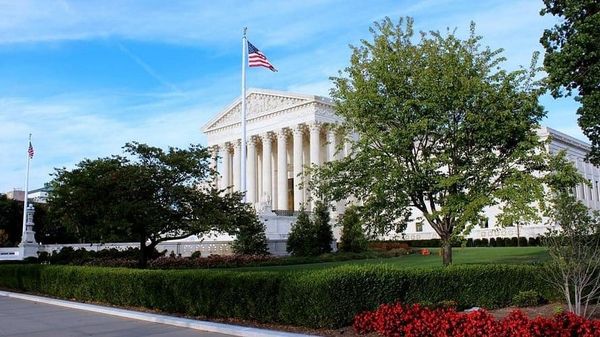
The Supreme Court's 2025–2026 term is being called one of the most consequential in recent memory. The docket includes major cases on executive power, administrative law, free speech in the digital age, and federalism. Rulings are expected through the end of June.
Most Americans will follow those decisions the way they follow a football game — tracking wins and losses, picking sides, measuring the score against their preferred outcome. That is understandable. It is also insufficient.
Because underneath every case on that docket — underneath the arguments about regulatory power, speech rights, and the limits of federal authority — sits a question that none of the briefs will ask directly. It is the same question the founders answered 250 years ago, and the answer they gave is either still operative or it isn't.
The question is this: where do rights come from?
THE STORY
The founders' answer was precise. It appears in the second sentence of the Declaration of Independence and it has not been improved upon in 250 years.
Rights are endowed. They are given — not by a government, not by a constitution, not by a court, but by a Creator. They are unalienable — meaning they cannot be transferred, surrendered, or revoked. They precede every government that has ever existed. The government's job is not to create them. The government's job is to recognize them.
That claim rests on a specific intellectual tradition. The founders called it the law of nature and of nature's God — the opening appeal of the Declaration. It was not a decorative phrase. It was a precise reference to a centuries-old framework: natural law.
Most state constitutions explicitly refer to natural or inherent rights. Virginia's declares that people are by nature equally free and independent and have certain inherent rights. Vermont's states that all persons are born equally free and independent and have certain natural, inherent, and unalienable rights. These were not rhetorical flourishes. They were legal commitments rooted in a specific understanding of what a human person is and where human dignity comes from.
The founders did not invent natural law. They inherited it — from Aristotle, from Cicero, from the English common law tradition, from William Blackstone's Commentaries, and most fundamentally from a theological tradition that understood the moral order of the universe as the expression of a lawgiving God. Inalienable rights are those inherent to all individuals regardless of government — pre-political, unable to be legitimately taken away by any authority. The founders believed this not as a political preference but as a statement of fact about reality.
WHAT IT REVEALS
There is a competing answer to the question of where rights come from. It is not argued out loud in most polite settings, but it operates beneath the surface of nearly every significant legal and political debate in America today.
The competing answer is that rights come from the government. They are granted by legislatures, recognized by courts, extended by executive orders, and defined by whoever controls the relevant institution at the relevant moment. On this view, a right is not a fact about human nature. It is a policy decision — subject to revision, expansion, or elimination as circumstances change and majorities shift.
This is not a fringe position. It is the operating assumption of a significant portion of American legal and political culture. And it is precisely what the founders were arguing against.
The difference between the two positions is not subtle. If rights are endowed — if they are pre-political facts about human dignity — then the government that violates them is not merely making a policy error. It is committing a moral offense against the order of creation. It is doing something wrong in a way that transcends majority opinion, legislative authority, and judicial precedent.
If rights are granted — if they are political decisions dressed up as principles — then no government is ever truly out of bounds. It is simply doing what governments do: deciding who gets what. The language of rights becomes a vocabulary for power rather than a constraint on it.
The living constitution approach acknowledges that the meaning and application of inalienable rights need to evolve with societal progress and shifting understanding of human dignity. That framing sounds reasonable. But notice what it concedes: that rights do not have a fixed meaning rooted in the nature of the person. They have a meaning that shifts with society — which means they have a meaning that shifts with whoever defines society's progress.
The founders would have recognized that argument. They rejected it.
THE FRAME
The phrase "the Laws of Nature and of Nature's God" was not casual language. In 1776 every educated person in the colonies knew exactly what it meant. It was a reference to a dual grounding for natural law — one available to reason, one available through revelation — that together established a moral order no human authority could override.
The reason foundation said: human beings, by observing the world and reasoning carefully about human nature, can arrive at moral truths that bind all people regardless of their particular religious commitments. Cicero had argued this. Blackstone had systematized it. The founders built on it.
The revelation foundation said something more specific: the God who created human beings in His image endowed them with a dignity that is not contingent on their usefulness, their productivity, or their political standing. That dignity is the source of rights. And the God who gave it is the authority to whom every government ultimately answers.
Together these two foundations produced a claim of extraordinary power: that the American experiment was not based on the preferences of the men who founded it, or the culture of the 18th century, or the political arrangements that happened to be available. It was based on something true about human persons — something that was true before America existed and would remain true if America ceased to exist.
That is what the founders meant. And that is what is at stake in every case the Supreme Court will decide before the end of June.
WHAT IT ASKS
The next time you read a Supreme Court decision — or a headline about one — ask a single question before you decide which side you're on: which answer to the rights question does this ruling assume?
Does it treat the right at issue as pre-political — as something the person possesses by virtue of being human, which the court is either recognizing or violating? Or does it treat the right as political — as something the court is extending, limiting, or redefining based on evolving social understanding?
That question will tell you more about the direction of the republic than any particular ruling's outcome. A court that recognizes rights it did not create is doing its job. A court that defines rights it did invent is doing something else — something the founders built the entire constitutional architecture to prevent.
This is not a conservative or liberal question. It is a foundational one. And Americans who cannot ask it cannot evaluate the answers being handed to them from the bench every June.
The founders gave you the framework. They called it the law of nature and of nature's God. It is 250 years old, it is still correct, and it is still the only answer that makes the word "unalienable" mean anything at all.
FURTHER READING
Commentaries on the Laws of England — William Blackstone (1765). The single most important legal text in the founders' formation — the source they cited most frequently when articulating natural law. Start with the introduction.
Natural Law and Natural Rights — John Finnis (1980). The definitive modern case for natural law as a foundation for rights. Rigorous, accessible, and still the standard reference.
THE GUARDIAN'S LENS
Every major case before the Supreme Court this term will be decided by nine justices. But the more fundamental decision — about whether rights are recognized or invented, endowed or granted — is being made every day by citizens who either know the founders' answer or don't. A court can only do so much when the people it serves no longer understand the premise on which its authority rests. The founders gave Americans a framework grounded in the law of nature and of nature's God. That framework is not a historical artifact. It is the operating system of the republic. And operating systems that go unmaintained eventually fail. Learn more at theguardianscross.org.
About The Guardians' Cross The Guardians' Cross is a formation and cultural engagement ministry helping Americans reclaim their identity, their nation, and their destiny. We publish The American Guardian three times a week — analysis that goes deeper than the headlines. If the ideas in this article resonate, there is more at theguardianscross.org.