The Crucible
Issue 30 | Thursday, April 30, 2026 | The Formation Forge
– 4 min read


Issue 30 | Thursday, April 30, 2026 | The Formation Forge
In April 1521, Martin Luther stood before the most powerful assembly in the Western world and was given a simple choice: recant everything he had written, or face the consequences.
He asked for one night to think about it.
The next day he came back and said no.
What produced that answer was not courage manufactured in the moment. It was the output of years of formation — Scripture embedded so deeply that he could not unsay what he had seen in it, prayer that had produced a clarity no institutional threat could displace, and a theological conviction that the authority behind him was incomparably greater than the authority in front of him.
Luther had already been excommunicated. His books were piled on the table in front of him. Johann Eck asked two questions: were these his writings, and would he recant?
Luther acknowledged the books. Then he asked for a day to consider the second question.
That night he prayed one of the most honest prayers in Christian history — not triumphant confidence but genuine need: "O God, Almighty God everlasting, how dreadful is the world! Behold how its mouth opens to swallow me up, and how small is my faith in Thee." He named his fear, his weakness, his smallness before the forces arrayed against him. Then: "Do Thou fight this battle — not mine but Thine. I have nothing to do here."
He came back the next day and said:
"Unless I am convinced by the testimony of the Scriptures or by clear reason — I am bound by the Scriptures I have quoted and my conscience is captive to the Word of God. I cannot and I will not recant anything. Here I stand. I cannot do otherwise. God help me. Amen."
The room erupted. Luther was declared an outlaw. Anyone could kill him without legal consequence.
He was spirited to Wartburg Castle and translated the entire New Testament into German in ten weeks — making Scripture available to ordinary people in their own language for the first time in the history of the German church.
The boldness at Worms was not the beginning of Luther's formation. It was the output of it.
He had entered the Augustinian monastery at Erfurt in 1505 in a moment of terror during a thunderstorm. He spent the next years gripped by one question: how could a sinful person stand before a holy God? He prayed for hours daily. He read. He confessed so compulsively that his confessor told him he was exhausting everyone around him.
And then, in the tower of the Black Cloister in Wittenberg, studying Romans 1:17 — "The righteous shall live by faith" — something broke open. He described it as being born again, as though he had entered paradise itself.
Everything that followed — the 95 Theses, the Leipzig Debate, the trial at Worms, the Reformation — was the output of a man formed by that single encounter with the Word of God.
He did not stand at Worms because he was brave. He stood because his conscience was captive to something he could not unsay.
Luther died in 1546 at sixty-two, still writing, still preaching. His last written words, found on a slip of paper beside his deathbed: "We are all beggars. That is true."
Luther is not a model for theological controversy. He is a model for anyone who has ever been in a room where the institutional pressure to be silent was enormous — and had to decide whether the authority behind them was greater than the authority in front of them.
He prayed the night before Worms not with triumphant boldness but with honest fear. The boldness came not from the absence of fear but from the presence of something that could not be unsaid. His conscience was captive to the Word of God. The institutional threat had no purchase there.
The authority given in Luke 10, the keys of Matthew 16, the incomparable power of Ephesians 1, the submit-and-resist posture of James 4 — all of it produces a person whose conscience is captive to the Word. And a person whose conscience is captive to the Word cannot be permanently silenced by institutional pressure.
They can be threatened. They can be declared outlaws. They can be driven into hiding.
But they come back the next day and say no.
Wednesday — For the First Time in 25 Years, People Are Coming Back to Church — the congregations that held their mission under pressure and came out more defined. Luther would have recognized exactly what produced that clarity.
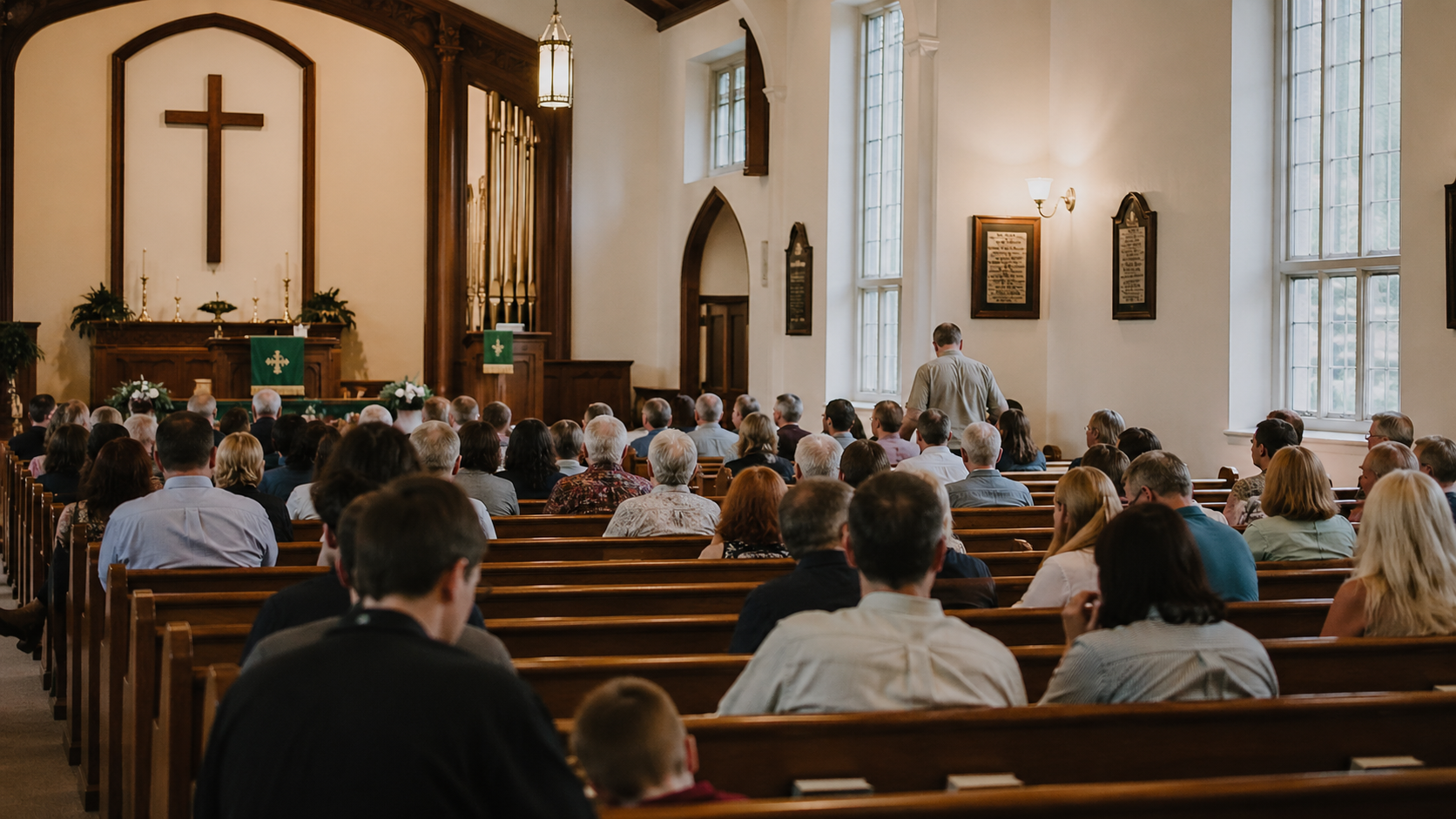
The press has been running the church-decline story for two decades. Last week, the Hartford Institute for Religion Research released data that complicates it significantly. The researchers were so surprised they went back and checked twice.
Luther stood in the most dangerous room of his life and said no to the most powerful institutions in the world.
He did not do it because he was fearless. He did it because his conscience was captive to the Word of God — and the Word would not let him unsay what he had seen in it.
Pray for boldness. Let your conscience be captive. Open your mouth.
Here I stand.